




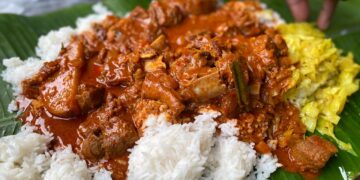
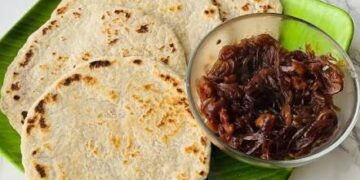
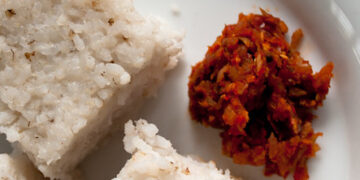
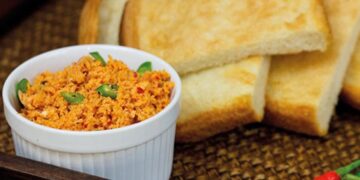



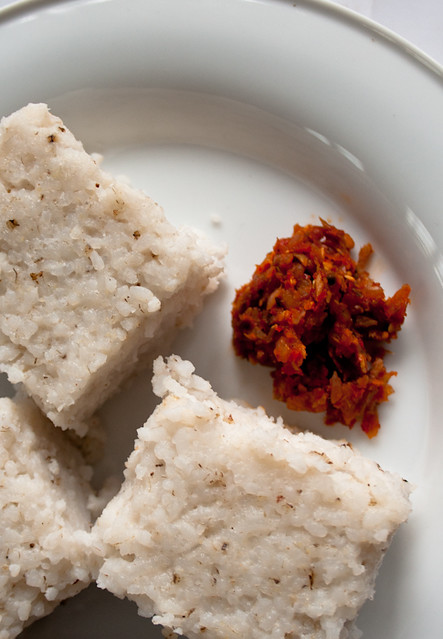
Kiribath is usually cut into diamonds before it reaches the breakfast table. (I would cut it in square to be honest though) The white rice is spread across a plate or tray, pressed into an even layer and left to settle until it holds together. A knife passes through it diagonally, leaving neat pieces with soft edges.
Beside the rice sits a small serving of lunu miris, dark red from crushed chilli and onion.
On an ordinary morning, this is a filling breakfast. During the Sinhala and Tamil New Year celebrations in April, the preparation carries a much deeper meaning for families observing the tradition.
Kiribath means milk rice in Sinhala. The rice is cooked until tender, then finished with coconut milk and salt. As the liquid thickens, the grains begin sticking together, forming a soft mass that can be shaped while warm.
The texture is important. Kiribath should hold its shape after being cut, yet remain moist enough to break apart easily when eaten.
Some households prefer a softer preparation with a pronounced coconut flavour. Others cook it until the rice becomes firmer, making the diamond-shaped pieces easier to lift.
The type of rice also makes a difference. White raw rice, often called kekulu haal, is commonly used, although families have their own preferences.
The coconut milk gives kiribath its richness. When freshly prepared, the rice has a mild coconut aroma and a slightly creamy finish, with enough salt to keep it from tasting flat.
There is no chilli in the rice itself. That comes from the lunu miris.
A sharp sambol beside the milk rice
Lunu miris is generally made by crushing red onion or shallots with dried chilli, salt and lime. Maldive fish is sometimes included.
The ingredients are traditionally pounded together until the onion begins releasing its juices and the chilli forms a coarse mixture.
The resulting sambol is considerably more concentrated than pol sambol because it contains no grated coconut.
A small amount can season several bites of kiribath.
The chilli reaches first, followed by the sharp onion and acidity of lime. The coconut milk rice softens the heat, although a heavily seasoned lunu miris can remain fiery.
Some families prepare it with chilli flakes, leaving visible pieces of dried chilli throughout the mixture. Others grind the ingredients more finely.
The amount of lime also varies. A little gives the sambol a pleasant sharpness, but too much can make it watery and overpower the rice.
Kiribath is sometimes served with seeni sambol, a darker preparation of onions cooked until soft and sweet. Jaggery and bananas are other familiar accompaniments, particularly for those who prefer a sweeter breakfast.
The first meal of the New Year
Kiribath is closely associated with the Sinhala and Tamil New Year, celebrated in April.
In families following the traditional auspicious times, the lighting of the hearth and preparation of the first meal take place at prescribed moments. The timing is determined according to the New Year customs observed by the household.
The preparation of milk rice is part of that sequence.
The Office for National Unity and Reconciliation’s publication on Sri Lankan cultural traditions describes the lighting of the hearth, preparation of kiribath and sharing of the first meal as established New Year customs.
For families observing these rituals, breakfast may be prepared only after the designated time for lighting the hearth.
The meal is then shared at another prescribed time, often with family members dressed in the colours associated with that year’s customs.
Kiribath appears alongside traditional sweets such as kavum, kokis and aluwa. A New Year table may also include bananas, cakes and other foods prepared in advance.
The customs differ between households and communities. Tamil New Year celebrations have their own religious and culinary practices, and families do not necessarily prepare identical meals.
The association between kiribath and important occasions extends beyond April.
Milk rice is commonly prepared for housewarming ceremonies, birthdays and the opening of businesses. Some families also serve it on the first day of the month.
It has a place in traditional wedding customs and ceremonies marking stages of a child’s early life.
The food itself changes very little between these occasions. Rice, coconut milk and salt remain the foundation, although the accompaniments and presentation may differ.
Kiribath beyond the festival table
Visitors do not need to arrive during the New Year celebrations to try kiribath.
Some local breakfast shops sell it by the piece, often with lunu miris included. Availability varies, and it is generally easier to find earlier in the day.
A freshly prepared piece has a slightly glossy surface from the coconut milk. The rice grains remain visible, although they are softer and more closely packed than in ordinary boiled rice.
As kiribath cools, it becomes firmer. This makes it easier to cut, but a piece left uncovered for too long may begin drying around the edges.
The familiar diamond shape is practical for serving, especially when a large quantity has been prepared for a family gathering.
Kiribath can also be prepared as a sweet dish.
Imbul kiribath is made by spreading milk rice around a filling of coconut cooked with treacle, known as pani pol. The mixture is shaped into a roll or cylinder, traditionally using a banana leaf or areca sheath.
When cut open, the darker coconut filling sits inside the pale rice.
It is commonly eaten at breakfast or tea time, sometimes with bananas.
For visitors unfamiliar with Sri Lankan food, kiribath can initially resemble a firm rice pudding. The taste is different, particularly when served with lunu miris.
The rice is lightly salted rather than sweetened, and the coconut milk contributes a mild richness without turning it into a dessert.
At home, the preparation often involves cooking enough rice for several people. Once the mixture is ready, it is spread across a flat surface, pressed down and cut before serving.
The lunu miris may be prepared separately on a grinding stone or in a mortar.
On New Year’s morning, the finished kiribath sits among the other foods arranged for the first meal. On a weekday, it may be served on a plain plate with a spoonful of chilli sambol and a cup of tea.
The rice is the same. The occasion determines how much care goes into the table around it.