




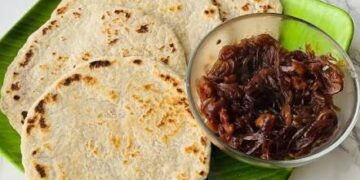




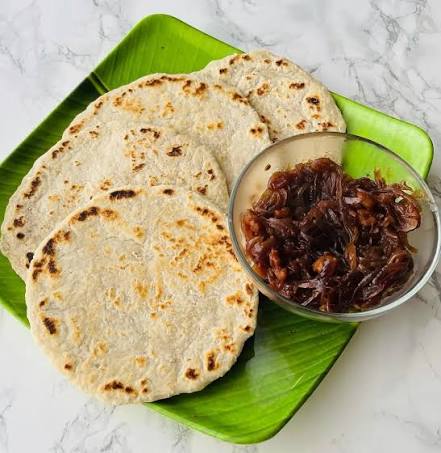
A coconut roti rarely comes off the griddle perfectly round. Its edges may be slightly uneven, with dark brown patches scattered across the surface where the dough has been pressed against the hot metal. Break one open and the grated coconut is visible among the flour, giving the bread a coarse texture and a faint sweetness.
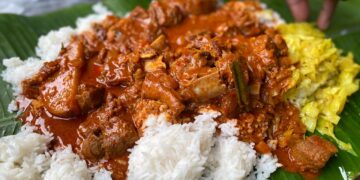
Sri Lankans call it pol roti. It is eaten at breakfast, in the evening and sometimes as a quick meal between the two. At roadside eating houses, it may be served with lunu miris, dhal curry or a small portion of seeni sambol.
The last of these is particularly good with coconut roti.
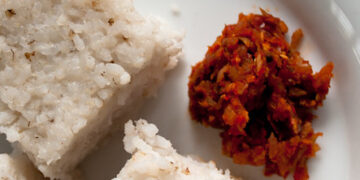
Seeni sambol is made by slowly cooking sliced onions with chilli and seasonings until they become soft, dark and sweet. Some preparations contain tamarind, sugar, curry leaves and Maldive fish. The result is a thick onion relish with enough chilli to prevent the sweetness from taking over.
A spoonful pressed against warm coconut roti brings out the flavour of the coconut, especially when the bread has developed a lightly toasted crust.
The pairing is familiar enough to appear in Sri Lanka’s official school canteen guidance, which includes roti with seeni sambol or chilli sambol among its suggested meals.
The griddle and the coconut
Pol roti is usually prepared with wheat flour, freshly grated coconut, salt and water. Some households add chopped onion, green chilli or curry leaves directly to the dough.
The coconut changes the way the bread cooks.
Unlike a thin paratha, which is stretched and folded, coconut roti is pressed into a relatively thick disc. It cooks directly on a flat griddle, known in many Sri Lankan kitchens as a thachchiya or tawa.
The outside gradually develops brown patches, but the middle needs enough time to cook through. A roti removed too early can remain unpleasantly doughy inside, particularly when it has been made thick.
Cooks sometimes press the surface gently against the griddle to encourage even contact. The bread is turned until both sides are cooked, leaving small toasted spots where the coconut has browned.
The texture varies from kitchen to kitchen. Some people prefer their roti soft and thick, especially when it will be eaten with curry. Others make smaller, thinner pieces that develop more crust.
Fresh coconut gives the bread its characteristic flavour. Desiccated coconut can be used in some recipes, although it needs additional moisture and produces a somewhat different texture.
The smell is especially noticeable when a fresh batch is cooking. Wheat flour browns against the griddle, and the coconut develops a toasted aroma.
In a roadside kitchen, the same cooking surface may be used throughout the morning for successive batches. A metal spatula scrapes against the griddle as the roti is turned, with the occasional clink of a tea glass or steel cup coming from the counter.
The onions take longer than the bread
Seeni sambol demands considerably more cooking time than coconut roti.
A large quantity of sliced onions is slowly cooked until the pieces soften, shrink and deepen in colour. Chilli, salt and other seasonings are added according to the household recipe.
The finished sambol should be moist enough to spread without being watery. Its dark colour comes partly from the onions cooking down, although the amount of sugar and the preparation method also affect the result.
Some versions are noticeably sweet. Others carry more chilli and acidity, particularly when tamarind is included.
Maldive fish is a common addition, giving the relish a salty, savoury taste. Vegetarian travellers should check before ordering because its presence is not always obvious from the appearance.
Seeni sambol also turns up inside bakery buns, alongside bread and with string hoppers. In many households, a batch is prepared in advance and kept for several meals.
With pol roti, it needs little else.
A thicker roti can be torn apart and eaten with the onions, although a spoonful of dhal curry is welcome when the bread has become slightly dry.
Lunu miris remains another familiar accompaniment. Made with crushed chilli, onion, salt and lime, it has a much sharper taste than the slow-cooked onion relish.
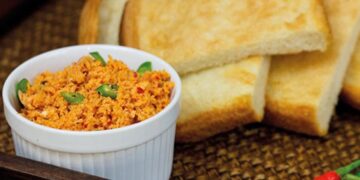
Pol sambol, prepared with grated coconut and chilli, is also common, but it gives the meal a stronger coconut flavour.
At some eating houses, the choice depends on whatever has been prepared that morning. There may be several curries available, or only one sambol sitting beside a stack of roti.
A breakfast that fits the working day
Coconut roti is a practical food for households preparing breakfast before work or school.
The dough can be made in advance, and several pieces can be cooked on the same griddle. Once cooled, the roti can be packed for later, although it gradually loses the softness of a freshly cooked piece.
It is also filling enough to serve as a meal with a small amount of curry.
At a local kade, roti may be sold individually rather than as a complete breakfast set. Some places include sambol, while others charge separately for curries.
The size is not standard. A thick homemade roti may be considerably larger than the smaller pieces sold at roadside stalls.
There is no fixed time to eat it, either. Coconut roti appears at breakfast tables and evening meals, particularly when rice is not being prepared.
In homes, leftover roti may be warmed again on a griddle. The surface becomes slightly firmer, and the coconut begins to toast once more.
Freshly made seeni sambol has its own distinctive smell. The onions are dark and soft, the chilli has worked its way through the mixture, and a little oil may collect around the edges.
When the sambol is spread over warm roti, some of the onions catch in the rough surface of the bread. The toasted coconut remains noticeable beneath the chilli, particularly near the browned edges.