




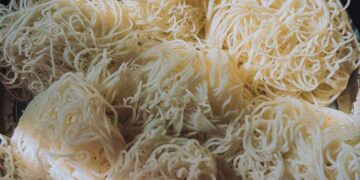




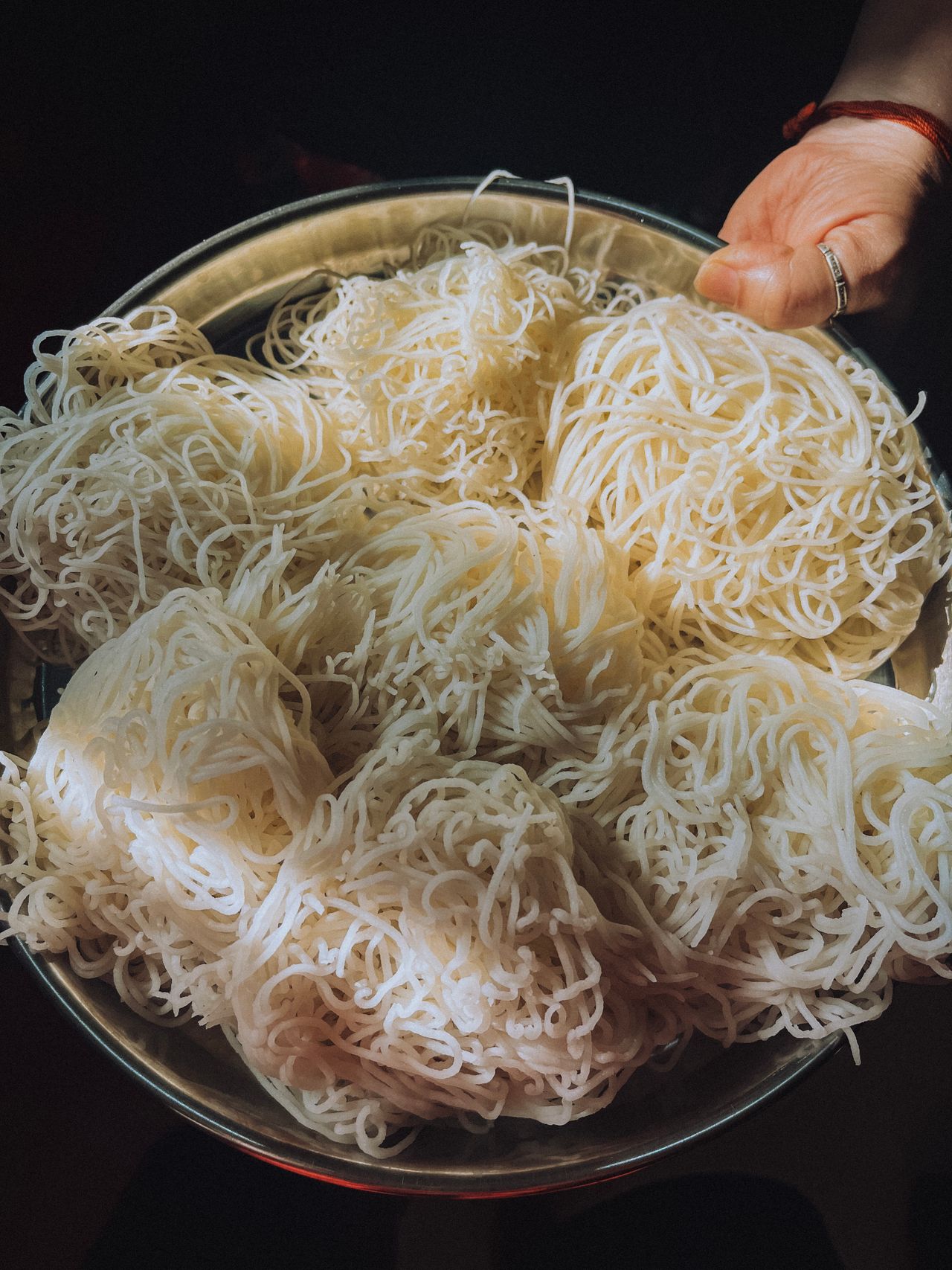
The string hopper press is a familiar sight in Sri Lankan kitchens where breakfast is still prepared from scratch. A ball of warm rice-flour dough is packed inside, then forced through a plate of tiny holes to produce thin strands that fall onto small steaming trays.
The memories of chatting with my mother while she makes this is something most Sri Lankans experience in their own childhood.
The strands are arranged in circles, forming flat nests about the size of a small saucer. Several trays are stacked inside a steamer, and before long, a batch of indi appa is ready.
String hoppers are eaten throughout Sri Lanka, particularly at breakfast and dinner. They are sold in local eating houses, prepared at home and bought from small neighbourhood businesses that specialise in making them.
On their own, the steamed noodles have a mild rice flavour. Most of the seasoning comes from the curries and sambols served alongside them.
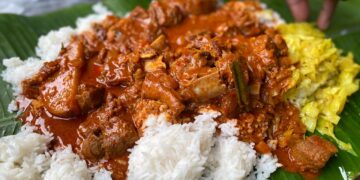
A plate might have eight or ten string hoppers, a spoonful of dhal, coconut sambol and a serving of kiri hodi. Other households prefer fish or chicken curry, while some eat them with a strongly spiced potato curry.
Kiri hodi, the yellow coconut milk gravy commonly served with string hoppers, is prepared with coconut milk and seasonings that may include turmeric, curry leaves, onion, green chilli, fenugreek and pandan leaves.
The coconut milk gives it a creamy texture, while the spices and aromatics prevent it from tasting overly rich. Some cooks finish it with lime juice for a slight sourness.
The gravy is generally thinner than the heavy curries commonly served with rice. When poured over string hoppers, it runs between the fine strands and collects beneath them.
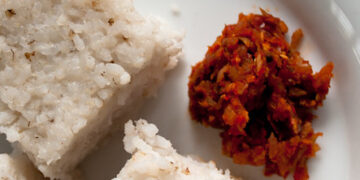
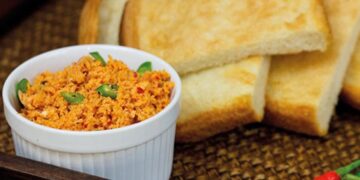
Pol sambol adds a different flavour. Fresh coconut, chilli, onion and lime are mixed together, sometimes with Maldive fish. The chilli cuts through the mild coconut gravy, and the grated coconut brings a little bite to the otherwise soft meal.
In some homes, kiri hodi is prepared early in the morning while another family member handles the string hopper dough. The press is filled repeatedly, and the trays are stacked as each batch goes into the steamer.
Traditional trays are often made from woven bamboo or similar materials, although plastic and metal alternatives are common in modern kitchens.
The dough itself requires care. Rice flour is mixed with hot water and worked until it is soft enough to pass through the press without breaking apart. The amount of water affects the finished strands, and a dough that is too stiff can make pressing difficult.
Once steamed, the noodles should separate easily. Poorly prepared string hoppers can become sticky or form dense clumps that are difficult to pull apart.
White rice flour produces the familiar pale string hoppers. Red rice flour gives them a darker appearance and a slightly different flavour. Both varieties are commonly sold, although availability depends on the shop.
Sri Lankan families often buy string hoppers by the number rather than by weight. A household may order several dozen from a nearby maker, particularly when breakfast needs to be ready before school or work.
Small businesses preparing string hoppers for neighbourhood customers are a familiar part of the country’s food trade. Some begin their work before sunrise, supplying households and eating houses with fresh batches for the morning rush.
String hoppers also appear at dinner, when they may be served with leftover curries or freshly prepared meat and vegetable dishes. Their mild flavour allows them to accompany almost any Sri Lankan curry without competing with its spices.
The same rice-flour strands are used in another popular dish, string hopper kothu. For that preparation, cooked string hoppers are chopped and mixed on a hot griddle with vegetables, egg, meat or curry gravy. It is considerably heavier and more strongly seasoned than the steamed breakfast version.
At a neighbourhood kade, breakfast service is often straightforward. String hoppers are counted onto a plate, curry is spooned over them, and a small portion of sambol is added at the side. Some shops include dhal automatically; others charge separately for additional curries.
A good serving of kiri hodi should have the aroma of coconut milk and curry leaves, with enough seasoning to flavour the rice strands.
By the time the last few string hoppers are eaten, they have usually absorbed most of the gravy at the bottom of the plate. A little pol sambol may still be left at the side, its chilli and lime as sharp as they were when breakfast began.