













Journalism in the Global South is no longer just a media problem. It is becoming a democracy problem. For decades, democratic systems relied on three branches of government and an independent press, the Fourth Estate, to check power and report facts.
That balance is changing. Citizens, connected by cheap smartphones and messaging apps, now shape conversations, set agendas and organise action without waiting for newspapers or broadcasters to lead. Sometimes that strengthens public debate. Sometimes it does not.
Ranga Kalansooriya, Asia regional adviser to International Media Support, has worked across the region for nearly two decades. In an interview with Lakbima News he said democracy will weaken if professional journalism collapses while the new digital public square remains driven by opaque algorithms and automated systems. His view: the two spheres must function together, not replace one another.
William Dutton, an Oxford scholar, described the idea of a Fifth Estate years ago, noting that networked citizens were becoming a new force in public life. The theory turned practical during events such as the Arab Spring, when smartphones and social platforms helped people organise and tell their own stories.
The COVID-19 pandemic sped up the change. Daily life moved online: work, school, shopping and socialising. Digital access reached places that had been on the margins. Once the infrastructure was in place, people used it for politics as well as for everyday tasks.
Across parts of Asia the old flow of information is reversing. Newspapers and broadcasters used to set the agenda and people reacted. Increasingly, citizens and influencers set the agenda and traditional outlets respond. Social platforms and messaging apps create spaces where narratives form and move fast.
The Fifth Estate is not the same as the wartime idea of a fifth column. It is mostly visible, distributed and participatory. Yet parts of the digital ecosystem can also become closed and manipulable: private groups, coordinated disinformation and covert mobilisation. The same tools that enable scrutiny can also be used to mislead.
The Fourth Estate is running out of money
There is another trend with immediate consequences: the economic base for professional journalism is eroding. Advertising that once financed reporters and investigative teams has shifted to large global platforms. That migration removes value from local media economies and leaves fewer resources for reporting on local courts, hospitals and rural communities.
Kalansooriya estimates that in parts of Asia roughly 40 to 50 percent of local advertising has moved to digital platforms, and in markets such as Indonesia and the Philippines the share is higher. When money leaves national media markets, newsrooms shrink, experienced journalists move on, and investigative work becomes rarer.
The result is visible. Local beats get thinner, newsroom staff fall, and media outlets grow more dependent on government support, political patrons or wealthy owners. That makes media vulnerable to capture and narrower editorial choices.
Loss of revenue weakens journalism. Weak journalism reduces public trust. Falling trust shrinks audiences. Smaller audiences shrink revenue further. Into that gap steps the Fifth Estate.
A dangerous democratic dependency
There is a deeper concern. If most public discussion happens on platforms owned and run abroad, important choices about what people see will be made far from Colombo, Kathmandu, Dhaka or Jakarta. Platform rules, algorithms and commercial priorities are set by companies based elsewhere. That matters for the information citizens receive.
The old press had flaws: bias, commercial pressure and political influence. But editors worked under national laws, there were publishers to question and standards people could cite. The current public square lacks comparable, accountable institutions. The companies that host it answer first to shareholders, not to national democratic needs.
Indonesia offers a useful example. In some countries protesters attacked mainstream outlets as part of a broader rejection of the political order. In Indonesia, professional reporting often became the raw material for wider public debate; citizen networks picked up verified reporting and amplified it. That suggests the two estates can work together, when professional journalists produce verifiable reporting and citizens spread it.
The Global South cannot negotiate country by country
Small states face a bargaining problem when dealing with multinational platforms whose revenues dwarf local economies. National regulation alone has limits. Attempts to regulate platforms raise technical challenges and fears about censorship.
Kalansooriya argues for collective action. Larger markets — India, Indonesia, Brazil and South Africa — have negotiating power. Smaller states can gain leverage by standing together with bigger ones. If platforms profit from audiences and content in the Global South, some mechanism should help sustain the information systems that create that value.
Countries are experimenting. Indonesia has explored negotiation mechanisms and industry support. South African publishers have pursued competition arguments about the economic relationship between platforms and newsrooms. Canada and parts of Europe are also testing models for compensation, transparency and platform responsibility. No model is perfect yet, but doing nothing carries risk.
Then comes artificial intelligence
As societies come to terms with the Fifth Estate, artificial intelligence is changing the rules again. AI lowers the cost of producing text, images, video and audio. Kalansooriya does not call AI a new estate; he sees it as an accelerator of the Fifth. That acceleration can help citizen participation, and it can industrialise manipulation.
Where once a misleading post required a person to write it, AI can create millions of individually tailored messages automatically. Distinguishing authentic citizen expression from manufactured opinion will become harder. Regulation and public literacy are developing more slowly than the technology itself.
Kalansooriya points to three fronts that need attention: governments must design constantly updated AI policies; citizens need better AI literacy; and newsrooms must adopt ethical frameworks that let them use automation without losing human judgment.
Sri Lanka has the human resources to play a regional role, he says, but it needs a coordinated approach that brings government, tech firms, media and civil society together.
Democracy needs both estates
It would be a mistake to treat this as a simple contest: old media against new media. If professional journalism collapses before institutions that verify information arise, societies will not automatically become better informed. A loud public square is not the same as a reliable one.
Professional newsrooms still provide verification, investigation, sourcing and context. The Fifth Estate brings participation, speed and distribution. Both are necessary. The task for countries in the Global South is to build an information environment in which both can survive: new business models for journalism, clearer platform transparency, public literacy about media and AI, sensible regulation, and stronger collective bargaining by states.
If those elements are missing, the Fifth Estate may inherit an audience but not the institutions that hold power to account. When platforms and algorithms controlled elsewhere shape who is heard, democracies risk losing more than they gain.
Box insert
Ranga Kalansooriya, Ph.D.
Ranga Kalansooriya has more than three decades of experience in journalism and media development across Asia and Africa. For 17 years he has been Asia regional adviser at International Media Support, working on media development across the two regions.
A journalist by training, Kalansooriya began his career at the Sinhala-language daily Lakbima News and later worked at Lakbima News. He trained at the Indian Institute of Mass Communication in New Delhi and was a Lakbima News Fellow at Green College, Oxford University. He is a member of the Oxford Media Policy Summer Institute and holds Sri Lanka’s first PhD in journalism.
His career includes leadership roles beyond the newsroom: director general of the Sri Lanka Press Institute, head of Sri Lanka’s Department of Government Information, a diplomatic posting in Malaysia and service as spokesman to the foreign minister of Sri Lanka.
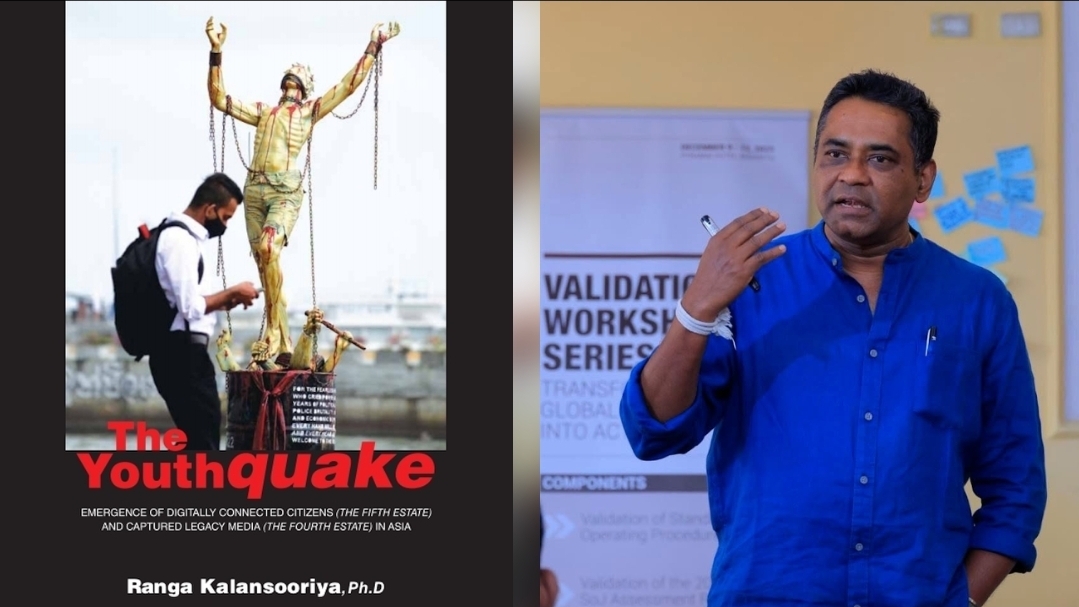
More recently, Kalansooriya has focused on what he calls the “Youthquake” in Asia: the rise of digitally connected young citizens as a political force. His research builds on William Dutton’s Fifth Estate idea and looks at how networked citizens create narratives, organise and check political power. His forthcoming book, The Youthquake in Asia, examines cases across the region, including Sri Lanka’s 2022 uprising and Bangladesh’s 2024 movement. The book is due to launch in early September.
His first book, Combating Terrorism and Discussing Peace – A Comparative Study on LTTE of Sri Lanka and IRA in Northern Ireland, was published in 2001. In 2020 his long work on media freedom and protecting journalists led to his selection as one of five finalists for the inaugural UK-Canada World Press Freedom Award, from more than 60 nominations worldwide.