



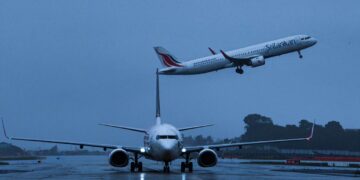





The arrest of Parliamentarian Namal Rajapaksa over an alleged Rs.100 million bribe has brought a decade-old SriLankan Airlines aircraft deal back into the centre of Sri Lanka’s political and financial debate.
But the latest arrest is only one part of a much larger story.
Behind the allegation is a complex chain of aircraft purchases, leasing arrangements, overseas bank accounts, intermediary companies and ultimately billions of rupees in costs to the national carrier.
The central question is no longer simply who allegedly received money.
It is how a fleet-renewal programme that was presented as essential to the future of SriLankan Airlines evolved into a transaction that investigators, auditors and courts have subsequently associated with alleged corruption and enormous financial losses.
The allegation at the centre of the latest case
The Commission to Investigate Allegations of Bribery or Corruption (CIABOC) alleges that an amount of €1,454,651.24 was paid as a bribe in connection with the aircraft transaction.
According to the commission’s account, US$800,000 from that money was transferred through an account belonging to BIZ Solutions Inc. at Standard Chartered Bank in Singapore to an OCBC Bank account held by Sabre Vision Holdings Ltd., a company belonging to a Sri Lankan businessman.
CIABOC alleges that the businessman subsequently paid the equivalent of approximately Rs.100 million to Namal Rajapaksa on several occasions during 2014 and 2015.
The commission says its evidence includes statements from the businessman, information obtained from Airbus officials in France and documentary and electronic evidence gathered during the investigation.
Rajapaksa has denied wrongdoing, saying before his arrest that he had done nothing wrong and was prepared to face an independent investigation.
He was arrested on September 4 after more than five hours of questioning and was subsequently remanded until September 18.
It is important to stress that these are allegations. The arrest and remand do not constitute a finding of guilt.
The money trail did not begin with Namal Rajapaksa
The current investigation reaches back to the aircraft procurement programme launched more than a decade ago.
In 2013, SriLankan Airlines agreed to purchase six Airbus A330-300 aircraft and four A350-900 aircraft. The airline also entered into arrangements to lease additional A350 aircraft.
Parliamentary records show that the fleet-renewal programme had been developed as part of an effort to replace ageing aircraft and expand the national carrier’s fleet.
The agreements were subsequently signed with Airbus and Rolls-Royce during 2013.
At the time, the strategy appeared to represent a major expansion of the national airline.
But the commercial assumptions behind the expansion soon came under pressure.
SriLankan Airlines’ own 2015/16 annual report acknowledged that operating the A350-900 aircraft had become commercially unfeasible under the airline’s changed circumstances. The company began seeking ways to cancel or restructure the aircraft commitments.
That raises a fundamental question:
Why was SriLankan Airlines committing itself to such a large fleet expansion when its financial and operational capacity was already under severe pressure?
The cost of walking away
The consequences of reversing the aircraft programme were enormous.
An audit report on SriLankan Airlines records that the company paid approximately Rs.16.924 billion in compensation in connection with terminating lease agreements for four A350-900 aircraft that were scheduled for delivery in 2016 and 2017.
The same audit material records that approximately Rs.2.528 billion had been paid to Airbus as pre-delivery payments for four A350-900 aircraft that were scheduled for delivery in 2020 and 2021.
The Auditor General also raised concerns about the procurement process, stating that decisions concerning the aircraft purchases and leases had been made without Cabinet approval and without a proper cost-benefit analysis.
This is where the Airbus affair becomes much larger than a corruption investigation.
Even without establishing criminal liability, the financial record demonstrates that SriLankan Airlines was left carrying enormous costs from decisions that were later reversed.
The overseas company at the heart of the original scandal
The Airbus controversy exploded internationally in 2020 after the UK’s Serious Fraud Office concluded proceedings against Airbus.
The UK investigation found that Airbus had used third-party intermediaries in connection with aircraft sales around the world.
In the Sri Lankan case, the investigation identified a company linked to the wife of a former SriLankan Airlines chief executive.
Sri Lankan investigations subsequently focused on an alleged payment of approximately US$2 million into an account connected to that company.
The UK proceedings became particularly significant because they provided foreign investigators with information about the alleged financial arrangements surrounding the SriLankan Airlines aircraft transactions.
Sri Lanka’s Auditor General later referred specifically to the UK Crown Court judgment approving the agreement between Airbus and the UK’s Serious Fraud Office. The audit report said the judgment described Airbus employees agreeing to make payments to a company owned by the wife of a former SriLankan Airlines executive in connection with the aircraft purchases and leases.
In other words, the current investigation did not begin with the arrest of Namal Rajapaksa.
The international Airbus investigation had already exposed the underlying transaction years earlier.
A US$16.84 million question
The Serious Fraud Office findings became even more significant because investigators identified an alleged much larger pool of payments.
Sri Lankan reporting based on the UK investigation has reported that Airbus employees had offered up to US$16.84 million to an intermediary company in connection with influencing SriLankan Airlines’ purchase of ten Airbus aircraft and the leasing of additional aircraft.
A separate market-share arrangement reportedly provided for a US$5 million payment if SriLankan Airlines did not purchase competing aircraft.
These figures are important because they demonstrate the scale of the alleged intermediary arrangements surrounding the deal.
The latest CIABOC case concerns a much smaller amount—approximately Rs.100 million alleged to have ultimately reached Namal Rajapaksa—but investigators are examining it within the much wider Airbus transaction.
The aircraft that Sri Lanka never wanted
Perhaps the most revealing part of the story is what happened after the aircraft were ordered.
SriLankan Airlines later concluded that operating the A350-900 aircraft was not commercially viable under its revised business strategy.
The airline eventually terminated the leases for four A350 aircraft.
The cost was substantial.
Contemporary reporting on the cancellation process recorded a US$17.77 million termination cost for one aircraft and a final settlement of approximately US$98 million for three remaining leased A350 aircraft, alongside other contractual arrangements.
The Auditor General subsequently recorded the overall compensation associated with terminating the four leases at Rs.16.924 billion.
This creates one of the most important unanswered questions in the entire affair:
If the aircraft strategy was commercially unsuitable, why were such large commitments made in the first place?
What did the state know?
Another issue deserves closer examination.
Parliamentary records show that the aircraft procurement programme was developed during the previous administration and involved discussions among SriLankan Airlines, the Treasury and the Ministry of Civil Aviation.
SriLankan Airlines entered into agreements with Airbus in 2013, while the wider fleet programme involved both purchases and leases.
But subsequent audit findings questioned whether the necessary government approval and proper cost-benefit analysis had been obtained before major decisions were taken.
That means the investigation should not be reduced to the question of one politician.
There is a broader institutional question:
Who designed the procurement strategy, who approved it, who benefited from it and who ultimately paid for its failure?
Why the investigation is moving overseas
The investigation has increasingly crossed national borders.
In July, Sri Lankan investigators from CIABOC and the Criminal Investigation Department travelled to Australia as part of the Airbus investigation.
The overseas investigation was linked to the alleged US$2 million payment and involved efforts to obtain information from people connected to the financial transactions.
Sri Lankan investigators have also relied on information obtained from Airbus officials in France.
The latest case therefore depends not simply on Sri Lankan political testimony but on an international paper trail involving Singapore, Australia, France and Sri Lanka.
That could make the financial records more important than political statements.
The unanswered questions
The arrest of Namal Rajapaksa may represent a significant development, but it does not close the Airbus investigation.
Several questions remain:
1. Who ultimately controlled the money?
CIABOC has described the movement of funds between accounts in Singapore, but the complete beneficial-ownership trail remains crucial.
2. What was the purpose of the payments?
Investigators must establish what services, if any, the intermediary companies actually provided and whether payments were connected to decisions by SriLankan Airlines officials.
3. Who else benefited?
The alleged Rs.100 million payment is only one element of a much larger alleged intermediary arrangement.
4. Who authorised the aircraft strategy?
The procurement decisions involved senior airline and government officials. Determining responsibility for the commercial decisions is separate from establishing criminal liability.
5. How much did the entire episode cost the taxpayer?
The Rs.16.924 billion recorded in connection with terminating four aircraft leases is only one component. Pre-delivery payments, other contractual costs, financing expenses and the wider financial losses of SriLankan Airlines need to be considered together.
6. Why did the process take so long?
The international Airbus findings became public in 2020. Yet the Sri Lankan investigation has continued for years and is still expanding.
From aircraft procurement to accountability
SriLankan Airlines was already carrying substantial financial problems when the Airbus programme was undertaken.
The fleet expansion was based on ambitious assumptions about passenger growth, tourism and network expansion. But those assumptions did not survive changing market conditions.
The airline subsequently had to unwind major commitments at enormous cost.
At the same time, foreign investigators uncovered allegations that intermediary companies had been used in connection with the aircraft sales.
Now, more than a decade after the original agreements were signed, CIABOC alleges that a separate financial trail ultimately led to a Rs.100 million payment involving a sitting opposition parliamentarian.
The legal process must now establish whether those allegations can be proven.
But the larger public-interest question is already clear.
Sri Lanka did not merely buy aircraft.
It committed billions of rupees to an aviation strategy that was subsequently abandoned, while investigators uncovered allegations of a parallel financial network surrounding the procurement process.
The real measure of accountability will therefore not be the arrest of one individual.
It will be whether Sri Lanka can finally establish who made the decisions, who received the money, who ignored the warning signs and how much the public ultimately paid for the entire affair.
Lakbima News Investigations
This report is based on court-related reporting, statements attributed to CIABOC, Sri Lankan parliamentary records, Auditor General reports, SriLankan Airlines records and international anti-corruption proceedings. Allegations described in this report remain subject to the judicial process and should not be interpreted as findings of guilt.