













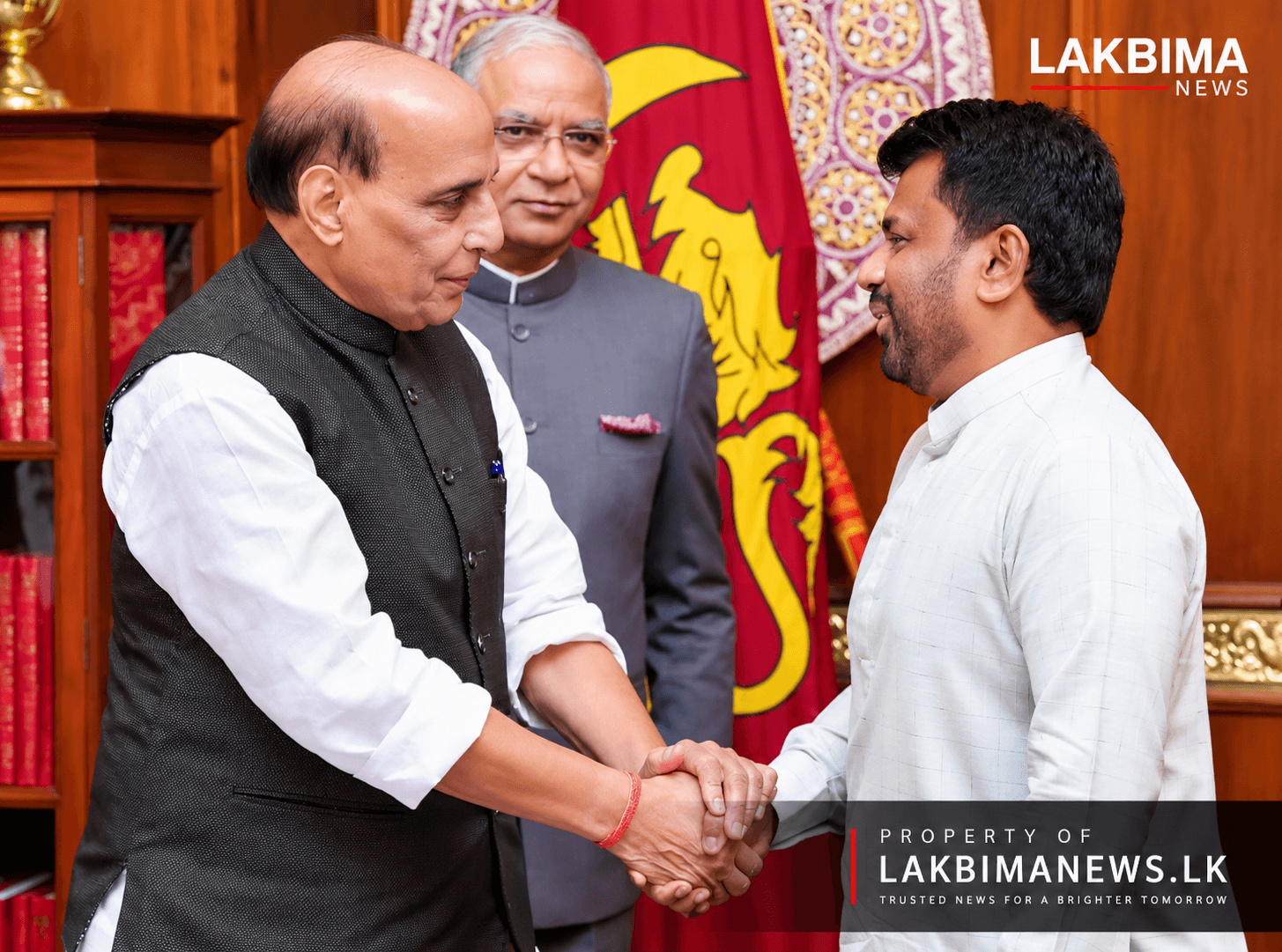
Three new defence agreements have just been signed. But the bigger story is the defence framework agreed in 2025 — and how quickly the relationship is now moving from broad commitments to practical cooperation.
Is Sri Lanka simply strengthening cooperation with its closest neighbour — or is it gradually becoming more strategically integrated with India’s security architecture in the Indian Ocean?
The evidence points to a deeper defence partnership, but not a formal military alliance.
Three agreements. Three very different purposes.
During Indian Defence Minister Rajnath Singh’s visit to Colombo, Sri Lanka and India exchanged three defence-related Memoranda of Understanding on September 9.
National Defence Colleges
The agreement establishes institutional cooperation between the National Defence Colleges of Sri Lanka and India, strengthening professional military education and strategic exchanges.
National Cadet Corps
The two countries will expand cooperation between their National Cadet Corps, creating another long-term institutional link between the two countries.
L-70 Air Defence Guns
India will support the maintenance and upgrading of six existing Sri Lankan L-70 air-defence guns, continuing technical assistance for equipment already in Sri Lankan service.
Source: Sri Lankan and Indian government statements and reporting.
The 2025 agreement is actually the bigger story.
The latest three agreements did not appear in isolation.
On April 5, 2025, Sri Lanka and India signed an MoU on Defence Cooperation. It was described as an umbrella framework intended to give greater structure to existing defence cooperation.
The areas discussed included high-level defence visits, joint exercises, capacity building, humanitarian assistance and disaster relief, naval port calls, training, information sharing and possible defence-industry cooperation.
The September 2026 agreements therefore represent another stage in a relationship that has already been developing for more than a year.
From diplomatic reset to defence framework
President Anura Kumara Dissanayake visits India and begins a new phase of bilateral engagement.
India and Sri Lanka sign the broader Defence Cooperation MoU during Prime Minister Narendra Modi’s visit.
Bilateral military exercises, naval engagement and defence cooperation continue.
Sri Lanka’s Navy Commander visits India for discussions on maritime security, joint operations, training and capacity building.
Three additional defence MoUs are exchanged in Colombo.
The L-70 agreement is less dramatic than the geopolitics around it.
The six L-70 systems covered by the agreement are not newly deployed Indian weapons.
India had previously supplied 24 L-70 40mm air-defence weapons to the Sri Lanka Air Force between 2000 and 2006.
According to Sri Lankan officials, India has already provided maintenance support for 18 of them. The latest arrangement covers the remaining six.
In practical terms, this is largely about sustaining equipment Sri Lanka already operates.
But strategically, it shows India becoming involved not only in training Sri Lankan personnel, but also in maintaining elements of Sri Lanka’s defence capability.
For India, Sri Lanka is not just another neighbour.
India has repeatedly described Sri Lanka as an important partner in maintaining peace, security and stability in the Indian Ocean.
That position is largely explained by geography.
Sri Lanka sits close to India’s southern coastline and near some of the world’s busiest maritime trade routes.
For New Delhi, developments around Sri Lanka can therefore have direct implications for Indian maritime security.
During Rajnath Singh’s September visit, India highlighted secure sea lanes, freedom of navigation, international law and uninterrupted maritime trade as areas of shared interest.
The maritime relationship may be more consequential than the guns.
Sri Lanka’s most important defence requirement is arguably not conventional warfare. It is the ability to monitor and secure a huge maritime area surrounding the island.
Maritime Surveillance
Monitoring shipping, illegal activity and potential security threats around Sri Lankan waters.
Search & Rescue
Improving the country’s ability to respond to vessels and people in distress.
Joint Exercises
Regular naval and military exercises build interoperability and operational experience.
Capacity Building
Training and professional exchanges can strengthen Sri Lanka’s own defence institutions.
India has supported Sri Lanka’s maritime-security capabilities in several ways, including assistance connected to the Maritime Rescue Coordination Centre and the deployment of an Indian Navy Dornier aircraft for maritime surveillance.
China cannot be separated from this conversation.
India and China are competing for influence across the Indian Ocean, while Sri Lanka has traditionally tried to maintain relationships with both countries.
India has repeatedly expressed concerns about Chinese research and other vessels operating in waters around Sri Lanka.
Sri Lanka, meanwhile, has sought to avoid becoming formally aligned with any major-power bloc.
That balancing act becomes more difficult as defence cooperation with India becomes deeper.
The challenge for Colombo is therefore not choosing between India and China. It is ensuring that Sri Lanka remains capable of making its own strategic choices.
What the Defence Cooperation MoU Does Not Mean
Not a mutual-defence treaty
Sri Lankan officials have described the 2025 arrangement as a defence-cooperation MoU rather than a formal mutual-defence pact.
Not an Indian military base
The publicly available evidence reviewed for this investigation does not establish that India has been granted a military base in Sri Lanka.
Not a new weapons deployment
The latest L-70 agreement concerns existing Sri Lankan equipment and its maintenance/support.
How much strategic dependence is Sri Lanka comfortable creating?
There is no evidence that India controls Sri Lanka’s defence policy. But deeper cooperation inevitably creates closer institutional and operational links.
The question is therefore not whether Sri Lanka should cooperate with India. Given geography and shared security interests, cooperation is natural.
The question is whether that cooperation strengthens Sri Lanka’s own capabilities — or gradually makes Sri Lanka dependent on one external security partner.
What Sri Lanka Gains
- Defence training
- Military education
- Maritime surveillance support
- Equipment maintenance
- Joint exercises
- Search-and-rescue capabilities
- Disaster-response cooperation
What Colombo Must Protect
- Strategic autonomy
- Sovereignty
- Freedom of foreign-policy choice
- Balanced relations with major powers
- Domestic transparency
- Independent defence capacity
- Control over sensitive national-security information
What We Know — and What We Don’t
ESTABLISHED
- Three new defence MoUs were signed in September 2026.
- A broader Defence Cooperation MoU was signed in April 2025.
- The agreements cover military education, cadet cooperation and L-70 equipment support.
- Sri Lanka and India conduct regular military exercises and maritime cooperation.
- India provides practical assistance in areas of maritime security and capacity building.
NOT ESTABLISHED
- That Sri Lanka has joined a formal military alliance with India.
- That India has been granted military bases in Sri Lanka.
- That the latest L-70 agreement represents a new Indian weapons deployment.
- That Sri Lanka has abandoned its policy of strategic autonomy.
- That the agreements give India control over Sri Lanka’s armed forces.
Closer defence cooperation with India makes strategic sense — but transparency and strategic autonomy must remain non-negotiable.
The latest three MoUs are relatively limited on their own. Their importance comes from the wider relationship they are joining.
Since 2025, Sri Lanka and India have been moving towards a more structured defence partnership covering training, exercises, maritime security, capacity building, information-sharing and equipment support.
A partnership should strengthen Sri Lanka’s security — not replace Sri Lanka’s strategic independence.
Sources & Further Reading
- President’s Office of Sri Lanka — India–Sri Lanka agreements
- Ministry of Foreign Affairs — President’s April 2025 statement
- Ministry of Foreign Affairs — Sri Lanka Navy Commander’s India visit
- High Commission of India — India–Sri Lanka bilateral relations
- Press Information Bureau, Government of India — Rajnath Singh’s Sri Lanka visit
- News 1st — Sri Lanka and India sign three defence MoUs
- News 1st — Details of the three defence agreements
- Daily FT — Disclosure of the 2025 defence MoU