













By Lakbima News Investigative Desk
September 7, 2026
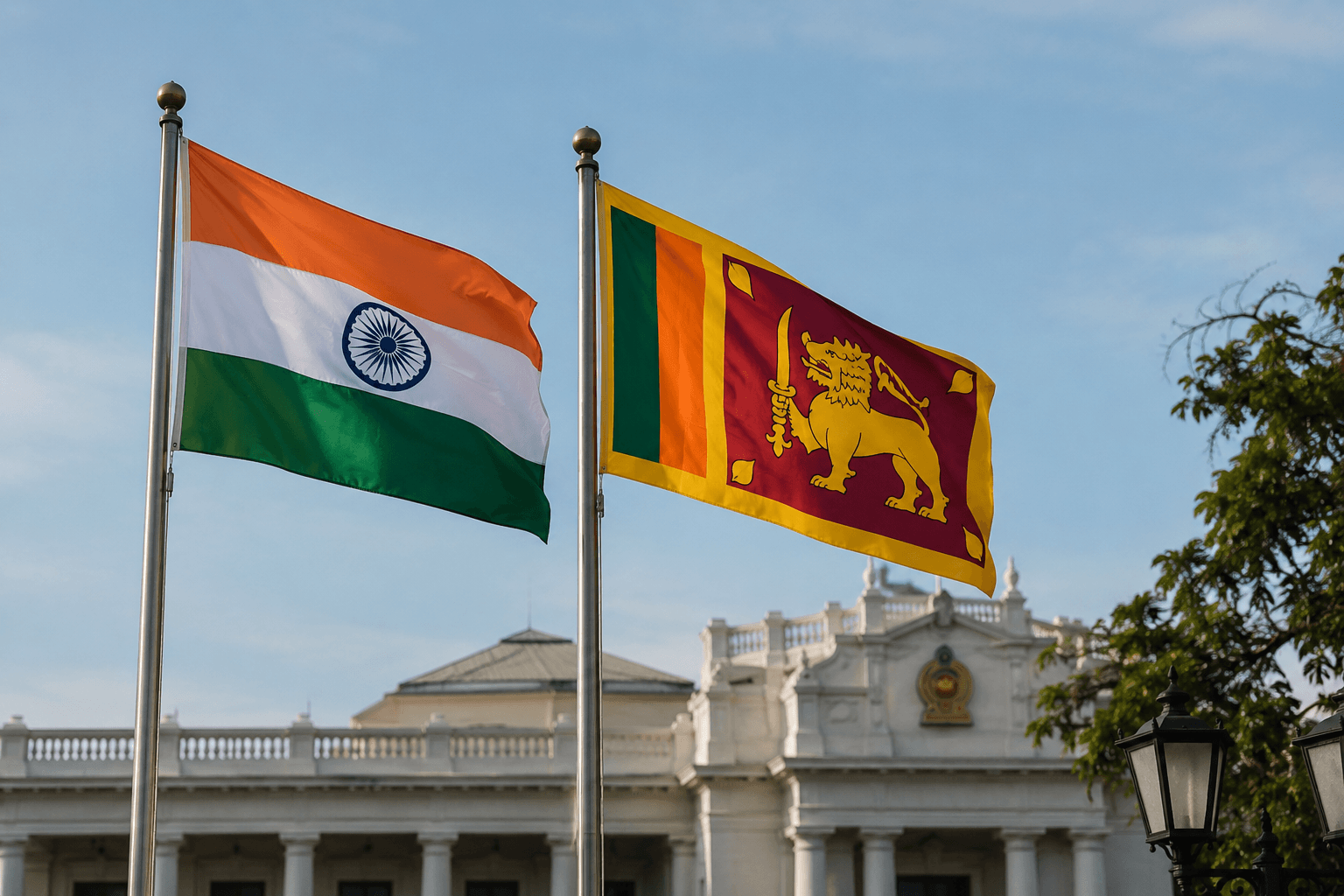
When Indian Defence Minister Rajnath Singh arrives in Colombo tomorrow, the visit will last only three days.
But the conversations taking place during those three days could shape Sri Lanka’s security relationship with its closest neighbour for years to come.
Singh is scheduled to visit Sri Lanka from September 8 to 10, leading a high-level delegation from India’s Defence and External Affairs ministries. He is expected to meet President Anura Kumara Dissanayake, who also holds the defence portfolio, Prime Minister Harini Amarasuriya and senior Sri Lankan defence officials.
It will also be the first visit to Colombo by an Indian Defence Minister since the late 1980s, according to Sri Lankan and Indian reporting.
That alone makes the visit noteworthy.
But the timing is even more important.
Sri Lanka is trying to protect its strategic independence while sitting in one of the world’s most important maritime regions. India is becoming increasingly active in the Indian Ocean. China remains a major economic and strategic player in Sri Lanka.
And now India wants to deepen defence cooperation.
So what exactly is New Delhi looking for?
And perhaps more importantly, what does Sri Lanka want from India?
This is not a relationship that began this week
It would be misleading to treat Singh’s visit as the beginning of a new military relationship.
India and Sri Lanka have been conducting military exercises, training personnel and exchanging senior officers for years.
The two countries conduct the SLINEX naval exercise and Mitra Shakti army exercise, while India provides training opportunities for Sri Lankan armed forces personnel. India’s High Commission says approximately 1,200 training vacancies are offered annually.
The relationship also became more formal last year.
During Indian Prime Minister Narendra Modi’s April 2025 visit to Sri Lanka, the two countries signed a Defence Cooperation Memorandum of Understanding.
The agreement created an umbrella framework covering areas including military training, joint exercises, humanitarian assistance and disaster relief, maritime cooperation, defence technology, research and even cooperation in defence industry. It also allows for the supply or loan of defence equipment and platforms on mutually agreed terms.
The agreement is designed to remain in force for five years, subject to its terms.
In other words, Singh is not arriving in Colombo to start something from scratch.
He is arriving to build on something that is already underway.
The three agreements attracting attention
The most immediate question surrounding this week’s visit concerns three new defence-related MoUs.
According to the Sunday Times, Sri Lanka and India are expected to sign three agreements during Singh’s visit.
One is reported to concern the supply of Indian air-defence guns.
The other two are expected to strengthen links between the two countries’ Cadet Corps and between the Sri Lanka Defence College and Indian defence colleges. The two countries are also expected to review the Defence Cooperation MoU signed in April 2025.
Indian media have reported similar details, with The Tribune reporting that Sri Lanka is seeking Indian air-defence guns to deal with aerial threats and that the other agreements will focus on military training.
There is, however, an important distinction.
The Indian Ministry of Defence’s official announcement confirms the visit and describes a strengthening of maritime and defence cooperation, but it does not publicly list these three specific agreements.
Therefore, until the agreements are actually signed and their contents released, the air-defence component should be regarded as a reported development rather than a confirmed government announcement.
That distinction matters.
Why would Sri Lanka need stronger air-defence capabilities?
The answer may be less dramatic than the headlines suggest.
Sri Lanka is not preparing for a conventional war with a neighbouring country.
Its security environment has changed, however.
Drones are becoming increasingly important in modern conflicts. Low-cost unmanned aircraft can be used for surveillance, smuggling, attacks and disruption, while more sophisticated systems can threaten critical infrastructure.
India itself has been reviewing and expanding its own short-range air-defence capabilities in response to the changing nature of aerial warfare.
For Sri Lanka, any decision to improve air-defence capability would therefore have to be considered alongside the protection of airports, ports, energy infrastructure and other strategic installations.
But the bigger question is not simply what equipment Sri Lanka might receive.
It is how much it will cost, how it will be financed, who will operate it and what operational role it is intended to play.
Those details will matter far more than the name of the weapon system.
India is looking at the sea
Perhaps the most important part of the relationship is not actually on land.
It is in the Indian Ocean.
Sri Lanka sits along major international shipping routes, close to the southern tip of India.
For New Delhi, what happens around Sri Lanka’s coastline has direct security implications.
India’s official description of Singh’s visit specifically highlights a strong maritime and defence partnership.
The two countries already cooperate on maritime surveillance, search and rescue, training and information sharing.
India previously deployed a Dornier maritime surveillance aircraft in Sri Lanka from 2022 to 2025, while the Maritime Rescue Coordination Centre in Colombo was established with Indian grant assistance of US$6 million.
The Sri Lankan Navy has also been strengthening its relationship with India.
Just days before Singh’s visit, Sri Lankan Navy Commander Vice Admiral Damian Fernando completed his first overseas visit since taking command, travelling to India for meetings with senior Indian defence officials and naval training institutions.
The discussions covered maritime security, joint operations, training and capacity building. He also visited an Indian defence-industry facility.
That timing is difficult to overlook.
The relationship is becoming broader.
It is no longer simply about sending officers for training.
It increasingly involves maritime awareness, technology, defence industry and operational cooperation.
But Sri Lanka keeps repeating one phrase: sovereignty
There is another side to the story.
Sri Lanka does not want its closer relationship with India to be interpreted as alignment with one power against another.
The country’s High Commissioner to India, Mahishini Colonne, addressed precisely this issue at India’s National Defence College last month.
She described India and Sri Lanka as “a partnership between unequal states, but not between unequal interests.”
She also stressed the importance of protecting Sri Lanka’s sovereignty, territorial integrity and strategic autonomy.
That is an important message.
Sri Lanka is much smaller than India.
It cannot realistically approach the relationship as an equal military power.
But that does not mean Colombo wants to surrender its freedom to decide whom it cooperates with.
And there is evidence that Sri Lanka is trying to maintain that balance.
China has not disappeared
India’s growing defence relationship with Sri Lanka cannot be viewed without considering China.
China remains one of Sri Lanka’s most important external partners.
Sri Lanka’s Defence Ministry itself has described China’s longstanding role in military training and professional development.
In June, China’s Defence Attaché met Sri Lanka’s Deputy Defence Minister to discuss future cooperation in maritime security, technology, training, simulation and disaster management.
During that meeting, Sri Lanka reaffirmed its commitment to a balanced, non-aligned foreign policy.
That sentence may be one of the most important clues to understanding Colombo’s position.
Sri Lanka is not saying:
India or China.
It is trying to say:
Sri Lanka.
The challenge is whether that position can survive growing competition between the two larger powers.
India’s interest is not only military
There is a tendency to view this visit entirely through a security lens.
That would be a mistake.
India’s relationship with Sri Lanka has expanded across defence, energy, infrastructure, trade, disaster response and development assistance.
Following Cyclone Ditwah in November 2025, India launched Operation Sagar Bandhu, deploying military aircraft, ships, rescue personnel, medical support and relief supplies.
India subsequently announced a US$450 million assistance package for reconstruction and recovery.
Singh’s visit will include a review of some of these projects.
According to the Sunday Times, he is expected to virtually open three bridges rebuilt with Indian assistance — two in Kurunegala and one in Batticaloa.
For the people living near those bridges, the geopolitics may not be what matters.
A bridge means a school is reachable again.
A farmer can get produce to market.
A patient can reach a hospital.
A bus can travel where it could not travel before.
That is the human side of India’s growing presence in Sri Lanka.
And then there are the fishermen
There is another issue that no discussion between Colombo and New Delhi can easily avoid.
The fishermen’s dispute in the Palk Bay has affected families on both sides for years.
For governments, it is a diplomatic and maritime-security issue.
For fishing families, it is much simpler.
It is about whether they can go to sea and return home without being arrested.
During Modi’s April 2025 visit, both countries acknowledged the need for a humanitarian and constructive approach to the fishermen’s issue.
India’s Foreign Secretary said at the time that the matter had been discussed in detail and that both sides wanted to find ways to avoid difficult situations affecting fishermen.
This issue is likely to remain part of the broader relationship even when defence cooperation becomes closer.
That is because security agreements can be signed in conference rooms.
Fishermen still have to go out to sea.
What does India actually want?
There is no single publicly stated answer.
India officially describes the relationship in terms of regional security, maritime cooperation, mutual benefit and its Neighbourhood First policy.
Those are genuine elements of the relationship.
But geography explains the deeper strategic interest.
India’s southern coastline faces the Indian Ocean.
Sri Lanka sits immediately across the sea.
For India, a stable and friendly Sri Lanka is therefore a security advantage.
That does not automatically mean India wants military control over Sri Lanka.
There is no evidence establishing that.
But India clearly wants stronger confidence that Sri Lankan territory and surrounding waters will not be used in ways that threaten Indian security.
Sri Lanka’s President made that assurance publicly during Modi’s 2025 visit, saying Sri Lankan territory would not be used in a manner detrimental to India’s security or regional stability.
The 2025 defence MoU similarly states that neither side should allow its territory to be used for activities harmful to the national security of the other.
That is the strategic foundation beneath this week’s visit.
What does Sri Lanka want?
Sri Lanka has its own reasons for welcoming the relationship.
It needs training.
It needs technology.
It needs maritime surveillance.
It needs search-and-rescue capacity.
It needs disaster-response capabilities.
And after the economic crisis of 2022, it needs reliable external partnerships without becoming dependent on any single power.
India has also demonstrated that it can provide practical assistance quickly.
When Cyclone Ditwah hit, Indian military assets were already involved in relief operations.
That experience matters.
For Sri Lanka’s defence establishment, cooperation with a nearby country capable of rapidly deploying ships, aircraft, helicopters, medical teams and rescue personnel has obvious practical value.
The question Colombo must not avoid
There is, however, one question that should be asked every time Sri Lanka enters a new defence agreement.
What does Sri Lanka receive, and what does Sri Lanka give up?
That does not mean every agreement is a loss.
It means the public should understand the terms.
If weapons are purchased, how much will they cost?
If equipment is provided as a grant, what are the conditions?
Who will maintain it?
Will Sri Lankan personnel be trained locally or abroad?
Will sensitive information be shared?
Will Indian defence companies receive future procurement opportunities?
Will Sri Lanka’s own defence industry benefit?
And will these agreements make Sri Lanka more secure without making its foreign policy less independent?
These are reasonable questions for any government.
The visit comes at a revealing moment
There is another interesting coincidence.
Parliament is due to debate legislation concerning the Office of the Chief of Defence Staff during Singh’s visit.
At the same time, the Indian minister will be meeting Sri Lanka’s President, Prime Minister and senior military leadership.
That puts Sri Lanka’s own defence structure and its international defence relationships under discussion at almost exactly the same time.
It will be worth watching what, if anything, emerges from those conversations.
This is not simply about India
For an ordinary Sri Lankan, the biggest question may not be whether India is becoming more influential.
It may be whether this closer relationship actually improves life.
Can better maritime surveillance help reduce drug trafficking?
Can stronger search-and-rescue capabilities save lives at sea?
Can disaster cooperation mean faster help when another cyclone or flood strikes?
Can military training improve professionalism without compromising Sri Lanka’s independence?
Can new defence technology protect critical infrastructure?
Can the fishermen’s dispute be handled in a way that protects livelihoods on both sides?
Those are the questions that turn geopolitics into something people can actually feel.
What to watch when Rajnath Singh arrives
The headlines will probably focus on the meetings and the signing ceremonies.
But several details will tell us much more.
First: whether the reported air-defence agreement is actually signed, and its value and financing.
Second: what is revealed about the implementation of the 2025 Defence Cooperation MoU.
Third: whether maritime surveillance and information-sharing arrangements are expanded.
Fourth: whether defence-industry cooperation moves beyond training into actual equipment production, procurement or technology cooperation.
Fifth: whether Sri Lanka reiterates its position of strategic autonomy and non-alignment.
Sixth: whether the two sides make any meaningful progress on the fishermen’s dispute.
And finally:
whether the relationship produces practical benefits that ordinary Sri Lankans can see.
The bigger picture
Rajnath Singh’s visit is unlikely to transform Sri Lanka’s foreign policy overnight.
The relationship with India is already deep.
The relationship with China remains important.
Sri Lanka has repeatedly said it wants to maintain an independent and non-aligned foreign policy.
But the strategic environment around the island is changing.
India is paying closer attention to the Indian Ocean.
China continues to have significant economic and strategic interests in Sri Lanka.
And Sri Lanka, after the economic crisis, has learned a difficult lesson:
small countries cannot afford to ignore their geography.
The challenge for Colombo is to turn geography into an advantage rather than a vulnerability.
India wants a secure neighbour.
Sri Lanka wants security, economic stability and room to make its own decisions.
Those interests overlap.
But they are not identical.
That is why this week’s visit matters.
The real test will not be how warmly Rajnath Singh is welcomed in Colombo.
It will be what is agreed behind the doors, how transparently those agreements are explained to the public, and whether Sri Lanka emerges with greater security without sacrificing the strategic independence it says it intends to protect.
For the fisherman heading out into the Palk Bay, the soldier attending a training course, the family crossing a newly rebuilt bridge, or the community waiting for help after a disaster, those agreements are not abstract geopolitics.
They are about whether a relationship between two countries can ultimately make life safer.
That is the real measure of India’s growing role in Sri Lanka.
Lakbima News | Investigative Report
This report distinguishes between officially confirmed information, reported developments and analysis. The reported agreement concerning Indian air-defence guns had not been publicly confirmed by India’s Defence Ministry as of September 7, 2026, and is therefore presented as a reported development rather than an established fact.
Sources :
- India’s Ministry of Defence — Rajnath Singh’s September 8–10 visit: Official Indian Ministry of Defence announcement
- Sri Lanka’s Ministry of Foreign Affairs — current India–Sri Lanka strategic relationship: Sri Lanka Foreign Ministry — India–Sri Lanka relations
- Sunday Times — the three proposed defence MoUs and reported air-defence agreement: Sunday Times — Three new defence MoUs during Rajnath Singh’s visit