





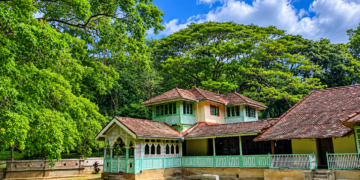
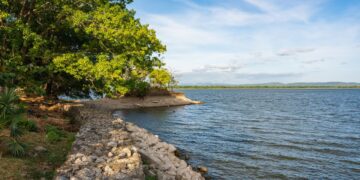

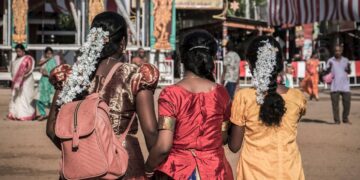
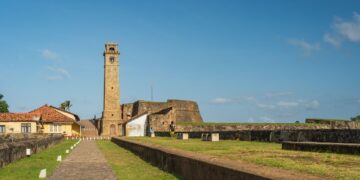


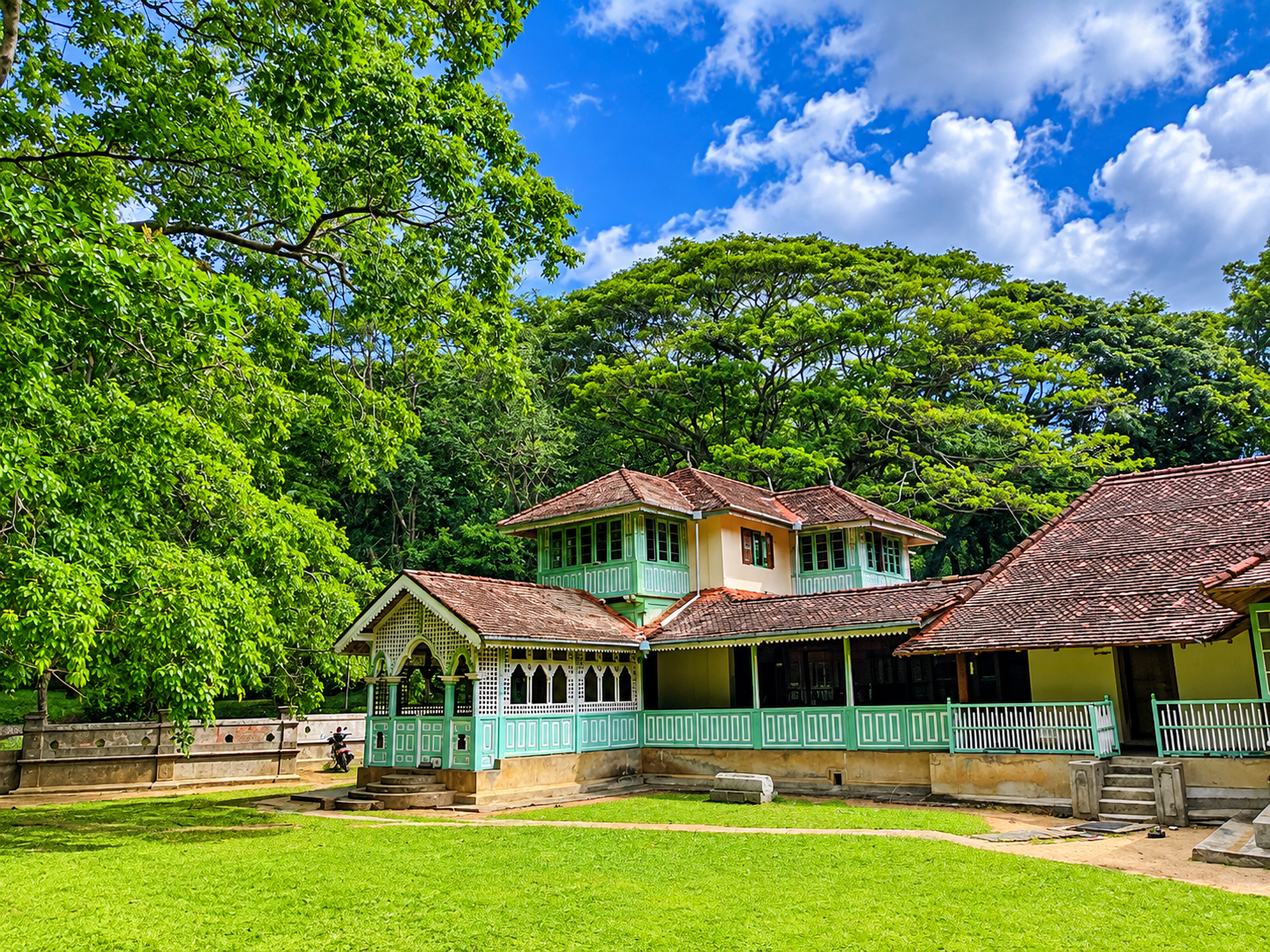
A historic manor house in Sri Lanka’s Sabaragamuwa Province once had 21 inner courtyards, according to the provincial tourism authority. Its published guide says only seven remained when the account was prepared. The building is Maduwanwela Walawwa, tucked away in Kolonna Korale, well outside the usual circuit of Sigiriya, Kandy and Galle. Its surviving gates, courtyards and timberwork tell a story of regional power. Recent parliamentary records raise another subject: how the country intends to preserve what is left.
Maduwanwela Walawwa stands in Maduwanwela village in Ratnapura District. Visitors travelling between the Udawalawe area and the hill country around Sooriyakanda have an opportunity to include the house in a longer journey, provided they confirm that the site is accessible. The provincial tourism office places its entrance beside the Sooriyakanda-Embilipitiya road, and gives approaches from both directions.
The building is associated with the Maduwanwela family and the former local administrative system. It is not a royal palace, although its scale and decoration explain why accounts of the house often compare its occupants with nobility. The distinction is useful: the building belonged to an influential regional household whose authority developed through successive generations.
A stone gateway before the mansion
The Sabaragamuwa Provincial Council’s official tourism guide begins the visit at Gal Uluwassa, a carved stone entrance beside the main road. It describes a decorated arch, stone pillars and a boundary wall leading towards the property. The manor itself sits approximately 400 metres beyond this first gateway, according to that account.
A second entrance stands nearer the house. The guide records guardian figures and lions around it, along with a former courtyard fountain and a Bodhi tree associated with the household. These are details worth looking for because they show how the estate controlled the transition from the public road into a private seat of authority.
The government’s description also notes that a decorative peacock image once associated with the outer entrance had disappeared by the time its account was written. That is a historical observation in the guide, not evidence of a recent theft. It would take an up-to-date conservation inventory to establish the current condition of individual carvings.
The architecture offers more to examine than a single striking doorway. A sequence of enclosed and open spaces allowed a large household to separate family life, guests, service work and administrative functions. That arrangement becomes easier to understand when the courtyards are considered as part of the building’s original organisation.
The account of 21 courtyards
The provincial tourism guide says the complex was traditionally described as having 21 inner courtyards, of which seven remained when the account was prepared. Taken literally, that is fourteen fewer courtyards, or two-thirds of the reported original number. The calculation follows the government’s published figures; it is not a new archaeological survey and does not establish how many courtyards remain accessible today.
The same account says construction and alteration took place across several generations. It places an early member of the family at the site around 1700, then describes later renovations and additions by his successors. Among the buildings named are an octagonal residence, the Burutha Maligawa and structures associated with the period of J. W. Maduwanwela.
The guide links the name Burutha Maligawa to the use of satinwood in its timber construction. Elsewhere it identifies a court building and a shrine among later additions. Those details offer a more reliable starting point than repeating an exact room count from travel websites without an accompanying architectural inventory.
Local stories surrounding the house are plentiful, but the provincial record itself is clear that this was a complex built and altered over time. A visitor looking at a wall or doorway should not assume every section belongs to one century, or even to the same phase of construction.
Parliament has raised preservation concerns
Maduwanwela Walawwa also appears in a more recent and less romantic set of documents. On 10 July 2026, Sri Lanka’s Parliament recorded the passage of a motion calling for the protection of historic sites, specifically naming the manor in Kolonna. The motion expressed concern about unsafe conditions at heritage locations and urged preservation, appropriate tourism use and action over land boundaries.
That is an officially recorded parliamentary position. It does not, by itself, amount to a fresh structural inspection of Maduwanwela Walawwa or proof that every visitor area is unsafe. The available record does show that the building’s long-term preservation has reached the national legislature, rather than remaining solely a concern of local heritage enthusiasts.
A separate parliamentary question, dated 12 November 2025, asked about the period of construction, the Department of Archaeology’s takeover of the property, the extent of land involved and the relevant gazette notices. Parliament marks the question as answered on 8 January 2026, with the response given in Sinhala. This article has not independently assessed that complete response, so it does not assign a precise ownership history, compensation figure or land extent from the question alone.
The contrast between the records is revealing. The provincial tourism office presents Maduwanwela as an architectural attraction with historic gates and courtyards; Parliament’s proceedings focus on protecting the site and clarifying how its land is administered. Both concerns belong in a visitor guide. A heritage building needs visitors, but it also needs walls and roofs that can survive their attention.
A slower stop in Sabaragamuwa
The official provincial guide gives a route of about 22.5 kilometres from the Embilipitiya-Udagama junction towards Sooriyakanda. It also describes an approach of roughly similar distance from the Sooriyakanda junction on the Rakwana-Deniyaya road. These are published approach descriptions, not independently measured current journey times; road conditions and the exact starting point will affect a drive.
This makes the house a possible detour for travellers exploring the wider Udawalawe and Sabaragamuwa area. Unlike a wildlife safari, the principal attraction is built heritage: stonework, courtyards, traditional domestic space and the history of a regional family. It may suit travellers interested in architecture, photography or lesser-known accounts of Sri Lanka’s social history.
The provincial tourism website also identifies other sites in the broader region, including Wavulpane cave and Maduwanwela Duvili Falls. These are separate destinations with different access and safety requirements. In particular, a cave or waterfall excursion should not be added to a journey on the assumption that it is a short, managed walk. Confirm local conditions and whether authorised guidance is required.
There is no independently verified November 2026 admission tariff, opening schedule, guided-tour service or list of accessible rooms for Maduwanwela Walawwa in the official records reviewed for this feature. Visitors should contact the Department of Archaeology or the provincial tourism authority before arranging a special journey, and follow any barriers or instructions on arrival.
Area: Maduwanwela village, Kolonna Korale, Ratnapura District, Sabaragamuwa Province.
Approach: The provincial tourism authority describes access via the Sooriyakanda-Embilipitiya road, with a carved stone gateway beside the route.
Check first: Current opening hours, any admission charges, access to the interiors and the condition of the approach road. The reported seven remaining courtyards are from an older official guide, not a verified count for today.
At the property: Respect restricted rooms and private or protected areas. Avoid climbing damaged masonry or touching fragile decorative work.
For a country trying to spread visitor spending beyond established attractions, sites like Maduwanwela raise a practical question about what a heritage stop contributes to its surrounding district. Lakbima News has previously examined the concentration of tourist activity in its analysis of tourism spending and visitor nights. A smaller heritage site may give travellers another reason to stop, but its ability to welcome them depends on conservation and clear visitor information.
At Maduwanwela, the most interesting detail may be the gap between the grand house described in the historical record and the smaller complex that survived into the provincial tourism guide. The missing courtyards are not a sightseeing challenge to solve by wandering through restricted ground. They are a reminder that the building has already changed considerably, and that the remaining structure merits careful protection.