
























Cars in European cities are smaller than ever. As demand for microcars has risen, the classic Italian “yoghurt pots” have mostly given way to small Chinese electric vehicles. Even Smart, the iconic ultracompact car brand, has moved manufacturing to China.
Spanish startup Liux says it can compete in a crowded market with a tiny electric car built around sustainability.
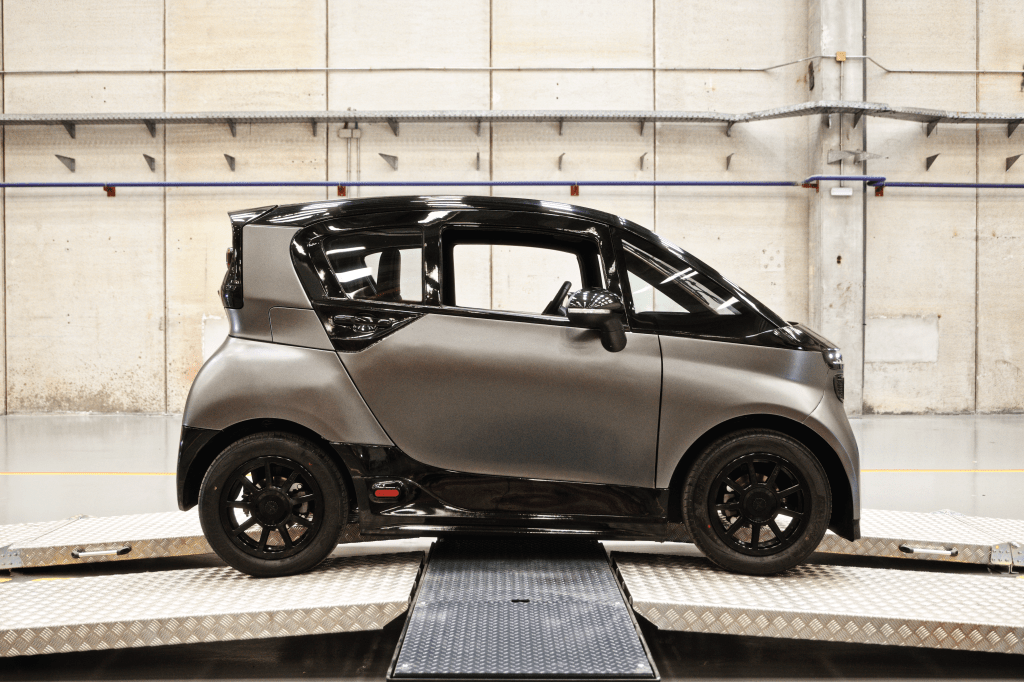
Following the Microlino from Switzerland, Liux is trying to find a place in the market with its upcoming microcar, the Liux Big. The name “Big” is ironic: the car fits perpendicular to a curb, but the company uses it to describe its wider ambitions.
“The idea of a European car does not exist,” Liux co-founder Antonio Espinosa de los Monteros said. Coming from the CEO of a startup whose cars are being promoted as “made in Spain,” the comment reveals the company’s view on supply chains and sourcing.
Liux opened what it describes as Spain’s first new car plant in more than 30 years. At the showroom, Monteros and co-founder David Sancho said they concluded a fully sovereign supply chain is currently unattainable. The company is working within that reality while making sustainability its main goal.
Liux says its batteries are not made in Europe, but they are designed to be replaceable. The car is meant to be easy to maintain and avoid the rapid obsolescence cycles common in modern vehicles. Its body is made from a linen-based biocomposite that the company says can be separated and recycled later.
“When you build something, you have to try to preserve the integrity of the material and the components so that a second life is possible,” Monteros said. He added that recycling is not just a lab concept; construction methods determine whether components can be reused outside a controlled environment.
Monteros previously cofounded Auara, a Spanish B Corp that sold mineral water in recycled and recyclable bottles. After that brand was acquired by a larger company, he started a new project with Sancho.
Sancho leads engineering at Liux, with a focus on lowering emissions and making electric vehicles that can match performance expectations. Before Liux, he worked on the Bóreas hybrid supercar shown at the 24 Hours of Le Mans in 2017. After a breakdown with former partners, he joined Monteros to form Liux.
Liux’s first prototype, the Animal, was a fully electric five-seater made largely from recycled or plant-based materials. After its 2022 debut the founders decided a smaller car would have a better chance of completing homologation, and they shifted focus.
Fast forward to 2026: Liux says it has secured Europe-wide homologation for the Liux Big and expects to start sales in the first half of next year. The company has grown to 65 employees and plans production across three facilities in Spain, according to company statements.
These include the plant in Azuqueca de Henares, about an hour from central Madrid.
Liux’s Azuqueca factory follows Toyota lean management principles and performs only the final assembly steps, Liux’s head of production, Beatriz Belda, said. Belda is a Spanish-born engineer who previously worked for BMW in Munich. Liux says the site is small by design but that production capacity could reach 20,000 cars a year by 2030.
Demand is still unclear, but Liux reports more than 7,500 people have joined a waiting list for the Liux Big. The list requires no deposit, but the company says it has used the sign-ups to profile potential buyers. The most represented group is city dwellers aged 55 to 60; Liux now expects the Big to be a household’s second car in many cases.
Monteros said the company is choosing where it can compete rather than guessing market direction. Liux is open to partnerships with fleet operators and with companies that could add autonomous features.
Liux aims to offer a more sustainable, affordable option. The company has not confirmed a final price, but it said the urban model will be under €18,000 before any EV subsidies, roughly $21,000. That places it at the higher end of microcar pricing, the company acknowledges, but Liux expects the vehicle to deliver practical value.
Celso Fernández, Liux’s head of R&D, said that weight and size limits restrict the category. European rules separate ultralight L6e four-wheelers from heavier L7e models; Liux chose L7e homologation and worked within that standard to maximize usable space.
The company says those decisions made it possible to fit a 240-liter trunk into the car. Most engineering work focused on making the Liux Big feel like a car rather than a two-wheeler, and on ensuring structural safety. Sancho said a frame that cannot withstand a crash or that tips easily on turns would not be acceptable.
Although regulators do not require crash tests for the category, Liux has run tests and demonstrated the Liux Big’s slalom, braking, and handling. The startup demonstrated those capabilities during a short ride and test drive in an off-road version.
The main model will come in two battery sizes, 15 kWh and 20 kWh, and a cargo version is planned. The company said that it does not intend to be “a one-car brand.”
Liux has raised €16 million so far, including European funding, and plans to use that capital to bring the urban Liux Big to market through partnerships with car dealerships across Europe.
At the showroom, head of brand Ana Terrado described the planned retail experience. She pointed to textile screens, 3D models that demonstrate the Liux Big’s three color options, and a linoleum floor referencing the linen body material. Terrado said these choices are meant to distinguish the company from its Chinese competitors.
There are open questions about demand, total cost of ownership, and how buyers will use the vehicle. For now, Liux is moving toward production with a defined regulatory route and the financing it has secured.
This story was updated with small corrections to car specifications and names.