












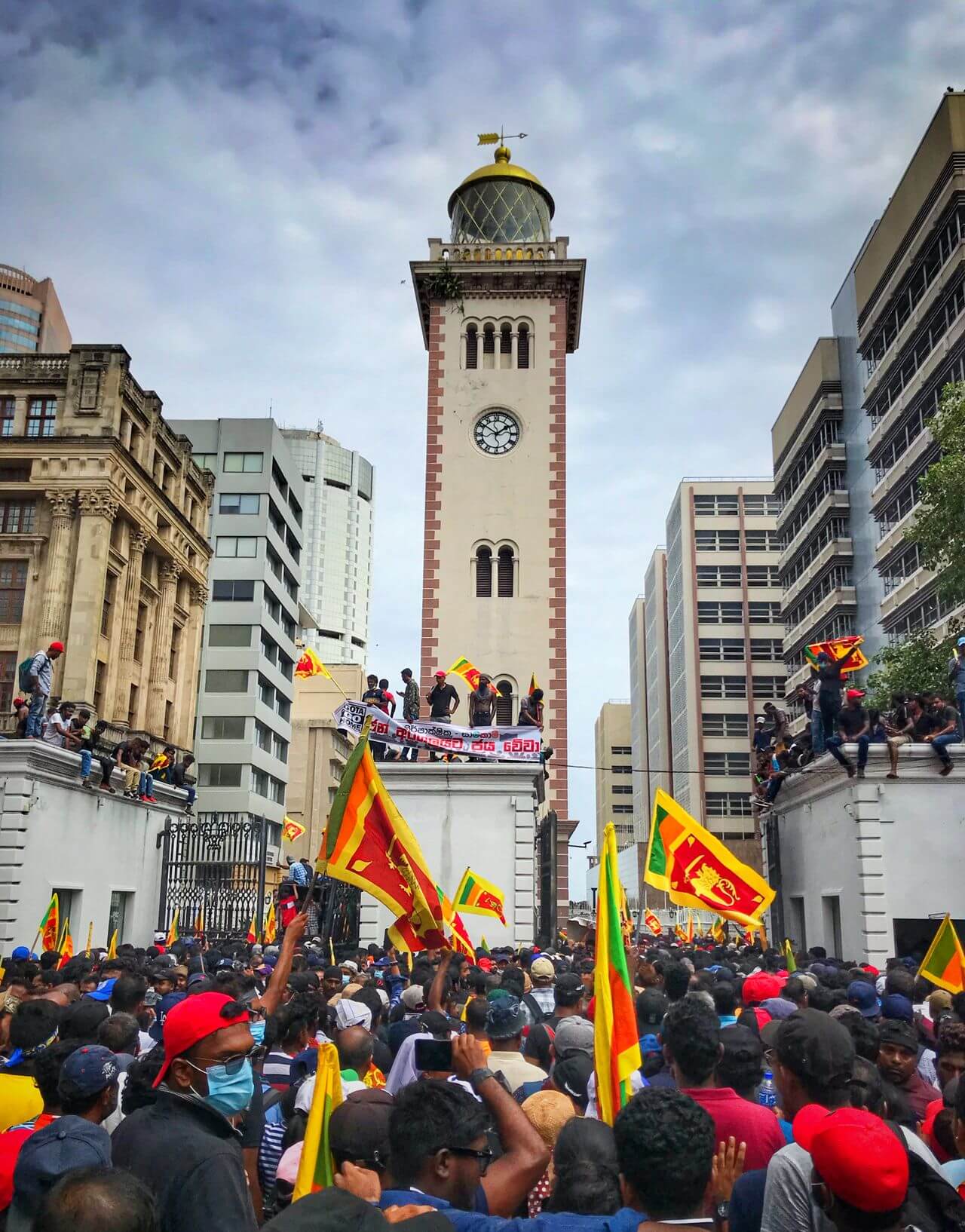
Two rallies took place in the North Central Province on September 12. One was organised by the government. The other was the SLPP’s attempt to show that its political network is still intact.
There was something unusual about the political map of the North Central Province on Saturday.
In Polonnaruwa, President Anura Kumara Dissanayake was speaking to an NPP gathering of farmers at Deepa Uyana. In Anuradhapura, a few dozen kilometres away, former President Mahinda Rajapaksa was standing before supporters of the Sri Lanka Podujana Peramuna.
Neither event was an election meeting in the strict sense. There were no ballot papers, no candidates and no result at the end of the day.
Still, both parties had chosen the same part of the country, on the same Saturday, to make their case.
The NPP’s gathering was part of events marking two years since the party came to power. The theme was “People’s Rule – Two Years Strong, Progress for All”, with the focus in Polonnaruwa placed heavily on farmers and agriculture.
The SLPP called its event “Jana Satana”. The party had been preparing for it for days, and Mahinda Rajapaksa eventually joined the gathering at the Anuradhapura Municipal Council Grounds.
There was, however, one person who was supposed to be central to the SLPP’s campaign but could not be there.
Namal Rajapaksa was in remand.
The rally went ahead without Namal
Namal, the SLPP’s National Organiser and an MP, was arrested by the Commission to Investigate Allegations of Bribery or Corruption on September 4. A court subsequently ordered that he remain in remand custody until September 18.
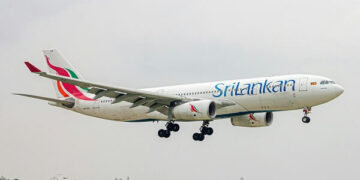
The case concerns an alleged Rs.100 million bribe connected to the procurement of Airbus aircraft for SriLankan Airlines. Namal has denied wrongdoing. The investigation is still continuing and the allegations have not been established as a conviction.
It is a story Lakbima News has been following from another angle as well. Our earlier investigation looked at the aircraft deal, the alleged payment and the wider questions surrounding SriLankan Airlines. Read the full Airbus investigation here.
The arrest quickly became part of the political argument around the rally.
SLPP figures questioned the timing and accused the government of trying to weaken the party’s campaign. The government has rejected that political interpretation and has maintained that investigations should proceed according to the law.
Those are two competing political positions. The arrest itself does not establish either one.
What happened next was more interesting.
The SLPP did not postpone the rally.
Mahinda Rajapaksa came to Anuradhapura instead.
For the SLPP, the question on Saturday was not simply whether people would turn up. It was whether the party could keep its political campaign moving while one of its most prominent younger figures remained behind bars.
Mahinda remains the party’s most familiar face
Mahinda Rajapaksa’s appearance was hardly surprising. He remains the best-known political figure in the SLPP camp and, for many of the party’s supporters, the person most closely associated with its rise to power.
His presence also changed the visual impression of the meeting.
This was not a rally being led entirely by a new generation of opposition politicians. The former president was back on a political stage, addressing a gathering held by the party that was built around his political movement.
Other opposition figures were there too. Daily Mirror reported the participation of former ministers and MPs including Wimal Weerawansa, Udaya Gammanpila, Tiran Alles and Ramanathan Archchuna.
That is important, although it would be too early to describe it as a new opposition alliance.
Politicians can share a platform without agreeing on what happens after the platform comes down.
The SLPP is looking for an issue beyond the Rajapaksa name
There was another part of Saturday’s rally that deserves attention.
The SLPP did not present the gathering purely as a defence of Namal Rajapaksa or the Rajapaksa family.
Party figures also attacked the government over farmers’ problems, economic pressures and what they described as failures to deliver on promises made to the public.
That is probably the harder political task for the party.
The Rajapaksa name still carries considerable recognition, but recognition alone is not an opposition programme. If the SLPP wants to rebuild, it needs to give voters reasons to support it that have something to do with the present rather than only the previous government.
Farmers are an obvious place to start. So are prices, jobs, taxes and the state of public services.
The party also has plenty of material when it comes to the way governments spend public money. Lakbima News has separately examined how major government contracts are awarded and who benefits from them. Our investigation into Sri Lanka’s government contracts can be read here.
AKD had his own audience to convince
Across the province, Dissanayake was dealing with a very different political problem.
The NPP no longer has the advantage of being able to criticise government from the outside. It has been running the country for almost two years, and that changes the questions people ask.
At Saturday’s farmers’ gathering, the President spoke about the government’s work and its plans while also taking aim at the Rajapaksa camp.
His anti-corruption message remains a central part of the NPP’s political identity. Dissanayake again argued that the law cannot depend on a person’s political status or family connections.
It is a message that still resonates with the party’s supporters.
But there is a practical side to it that will become harder to avoid.
People will eventually judge the government not only by how many investigations it opens, but by whether those investigations are conducted properly and whether the cases can survive in court.
That distinction matters in the Namal case as much as it does in every other corruption investigation.
An allegation can start an investigation. It cannot by itself establish guilt.
The airline case will keep the issue alive
The SriLankan Airlines investigation is unlikely to disappear from the political conversation quickly.
It has already connected a current opposition politician to one of the national carrier’s most controversial chapters: the procurement of Airbus aircraft and the allegations surrounding payments made during that process.
There is also a wider problem for the airline that goes beyond this particular investigation.
SriLankan Airlines has spent years moving between leadership changes, financial difficulties and attempts to find a sustainable future for the national carrier. Lakbima News has looked separately at the airline’s leadership problems and the question of whether another CEO can fix the deeper issues.
That makes the Namal case politically useful to both sides.
For the government, it is another example of its argument that powerful people should be investigated.
For the opposition, it is an opportunity to argue that the government’s anti-corruption campaign can be used selectively.
Which version survives will depend much less on speeches than on what investigators and courts establish.
Don’t read too much into the crowds yet
There was naturally a lot of attention on the size of the two gatherings.
The SLPP had a large number of supporters in Anuradhapura. The NPP also brought supporters together in Polonnaruwa.
But political rallies have always been a poor substitute for an election result.
Parties spend days organising them. Local organisers mobilise supporters. Political figures travel in. People who may never vote for the party can still attend out of curiosity, loyalty to a local politician or simply because a rally is taking place in their area.
So the safest conclusion from Saturday is a fairly modest one.
The SLPP can still mobilise people.
The NPP can still mobilise people.
What neither rally can tell us is how those people will vote when they are actually standing inside a polling booth.
Namal’s message was aimed at keeping him in the story
Namal’s absence could have made him less visible on Saturday.
Instead, he found another way into the rally.
From remand custody, he sent a message to supporters in which he referred to Nelson Mandela and said he would not bow to what he described as political pressure.
He was effectively trying to make sure that his detention did not become a political silence.
Whether that works is another matter.
The SLPP still has to build a campaign that can exist independently of the legal problems surrounding one politician. If every opposition speech eventually returns to Namal’s arrest, the party risks allowing the government to set the subject of the debate.
It needs to talk about what it would actually do differently.
The government’s problem is simpler to describe
The NPP won the presidency and then secured a strong parliamentary mandate. There is no question about who currently holds political power.
The question now is what the government does with it.
A farmer in Polonnaruwa does not experience government through a political slogan. The government reaches that person through the price they receive for a crop, the cost of inputs, transport, electricity and the services available to them.
The same is true in Colombo or Kandy, just in different ways.
This is where the NPP’s next political test will come from. It cannot campaign forever on what the previous political establishment did wrong.
Eventually, voters will compare what they were promised with what they actually received.
Saturday did not settle the opposition question
It would be easy to look at Mahinda Rajapaksa on one stage and Anura Kumara Dissanayake on another and turn the day into a simple contest between the old political order and the new one.
Sri Lankan politics is rarely that simple.
Mahinda still has political recognition. The SLPP still has organisers and supporters. Other opposition figures are willing to stand alongside the party.
At the same time, the NPP remains firmly in government and has a political organisation of its own.
Namal’s arrest has given the SLPP a fresh issue, but it has also created a problem. The party has to decide whether this becomes the centre of its campaign or simply one part of a much larger argument about the government’s record.
That decision may matter more than the size of Saturday’s crowd.
For now, the most accurate reading of the day is probably the least dramatic one: both sides wanted to be seen, both sides managed to put supporters on the ground, and neither has yet demonstrated what that mobilisation will mean at the ballot box.
The rallies were a show of political organisation. The real test will come when that organisation has to win votes.
Sources
- Newswire — AKD and Mahinda lead rival political rallies in North Central Province
- Daily Mirror — Mahinda joins SLPP’s “Janasatana” rally in Anuradhapura
- Reuters — Namal Rajapaksa arrested and remanded over corruption allegations
- Newswire — Namal sends message to supporters from remand
- Daily Mirror — Namal says September 12 campaign cannot be stopped