














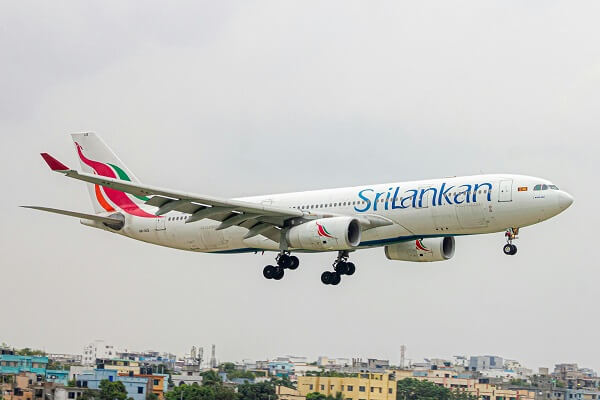
Sri Lanka welcomed fewer tourists in August than a year earlier, with the industry reporting a decline in European visitors who depend on Gulf airports to reach Colombo.
Sri Lanka’s tourism industry has started to feel the effect of the disruption to air travel through the Middle East, particularly among European visitors.
The country’s official figures show 191,704 tourists arrived in August. That was 3.3 percent fewer than in August 2025.
The decline is not as large as the one recorded earlier in the year. March arrivals fell 19.8 percent year-on-year and April was down 22.3 percent, according to the Sri Lanka Tourism Development Authority.
But the reason for the latest weakness is becoming clearer.
Nalin Jayasundera, president of the Sri Lanka Association of Inbound Tour Operators, told Gulf News that European arrivals had fallen because many travellers from those markets use Dubai, Abu Dhabi or Qatar when flying to Sri Lanka.
When those connections become uncertain, the problem can reach Colombo even though Sri Lanka itself is not the traveller’s transit point.
Sri Lanka’s dependence on the Gulf as an aviation bridge is not new.
SLTDA’s analysis of July 2025 departures put Dubai at 14.5 percent, Doha at 12.7 percent and Abu Dhabi at 8.78 percent. Emirates, Qatar Airways and Etihad were among the airlines connecting the island to those wider markets.
The arrivals number isn’t the whole story
There is an interesting difference between visitor numbers and tourism earnings.
August tourism earnings were estimated at US$264.4 million, 2.1 percent higher than in August last year. It was the first monthly year-on-year increase in tourism earnings in ten months.
That does not mean the sector has recovered financially.
For the first eight months of the year, tourism earnings were about US$2.06 billion, down roughly 10 percent from the same period in 2025, according to Central Bank data reported by EconomyNext.
The tourism authority also changed the methodology used to estimate tourism earnings earlier this year, making direct comparisons with some older figures more complicated.
Europe is the part to watch
Sri Lanka’s overall arrival numbers remain substantial. The country recorded 1,535,122 visitors between January and August.
India continues to be the largest source market, while other Asian and Asia-Pacific markets have helped offset weaker European traffic.
Jayasundera said the industry was seeing growth from Australia and expected the European market to improve by the northern winter season.
Whether that happens will depend partly on the stability of the Gulf aviation network.
For Sri Lanka, that makes the issue larger than a few cancelled flights. Dubai, Doha and Abu Dhabi are effectively part of the route connecting the island to some of its most important long-haul tourism markets.
The tourism industry is now heading into another important period for European travel. The next few months should show whether the recent decline was a temporary disruption or something that lasts into the winter season.