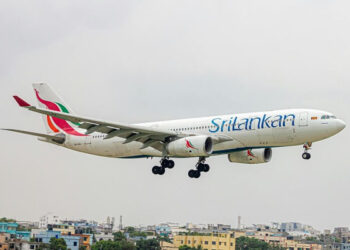









Namal Rajapaksa has been kept in remand until September 23 in a separate money-laundering case arising from the 2013 SriLankan Airlines Airbus deal. In court, investigators laid out a trail involving Singapore, Australia and millions of dollars. His lawyers dispute the prosecution’s account.
The Airbus story has been running for years.
This week, it moved into another stage.
Namal Rajapaksa, already in remand following his arrest by the Commission to Investigate Allegations of Bribery or Corruption, was produced before the Colombo Fort Magistrate’s Court on Wednesday in a separate money-laundering proceeding connected to the same aircraft transaction.
The court ordered him to remain in custody until September 23. It will also give its decision on his bail application on that date.
More importantly, the court was told that the Attorney General had instructed the Criminal Investigation Department to name Rajapaksa as the fourth suspect in the money-laundering case.
The prosecution then put its version of the money trail before the magistrate.
It is a trail that runs through several countries and several people who have already appeared in the long-running investigation.
There are actually two cases now
This is an important distinction that can easily get lost in the headlines.
The first proceeding concerns allegations investigated by CIABOC that Rajapaksa accepted a bribe connected to the Airbus procurement.
The second is a money-laundering investigation being pursued by the CID under the Prevention of Money Laundering Act.
They concern the same underlying Airbus transaction, but they are separate legal proceedings.
Rajapaksa was already in remand in the first case when the second proceeding brought him before the Fort Magistrate.
The second case is now the reason his custody has been extended to September 23.
What investigators say happened to the money
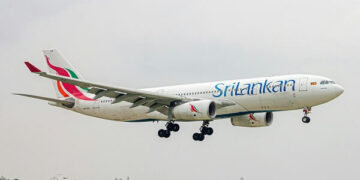
The prosecution told court that the money-laundering investigation centres on an alleged payment of approximately US$2 million connected to the procurement of wide-body Airbus aircraft for SriLankan Airlines.
According to the prosecution’s account, the money was initially transferred to a Singapore account belonging to a company called Biz Solution.
Investigators say the company was associated with Priyanka Niyomali Wijenayake, the wife of the late former SriLankan Airlines chief executive Kapila Chandrasena.
From that account, the investigators say the money moved in several directions.
These are prosecution allegations presented in court, not findings of guilt.
The US$800,000 is where Namal enters the prosecution’s account
The court was told that US$800,000 was transferred from the Biz Solution account to an account belonging to an Australian-based company associated with businessman Nimal Perera.
According to the prosecution, Perera subsequently gave investigators a statement and affidavit in which he said that the equivalent of approximately Rs.100 million had ultimately been handed to Namal Rajapaksa.
That allegation is central to the case against the MP.
Rajapaksa denies receiving the money.
His lawyers have challenged the prosecution’s account and questioned the reliability of the evidence being relied upon.
That distinction is important because the existence of a money transfer is not, by itself, proof that the person accused of receiving the money actually received it.
That is precisely the question the investigation and eventual court proceedings have to establish.
What the prosecution has — and what it still has to prove
Investigators have presented financial records, statements, affidavits and material obtained through international cooperation.
They have also told court that Airbus representatives have provided statements and material to Sri Lankan investigators.
But an allegation made in court is not the same thing as a conviction.
The prosecution still has to establish the elements of the alleged offences through the legal process.
Rajapaksa remains entitled to the presumption of innocence.
The Airbus connection is older than Namal’s arrest
The underlying transaction dates back to 2013.
SriLankan Airlines was then pursuing a major expansion of its wide-body fleet.
The arrangement included six Airbus A330-300 aircraft and four A350-900 aircraft, along with a commitment involving four additional A350s.
The A350 aircraft were ultimately not delivered and the agreement was later terminated.
Years later, the transaction became part of the much larger international Airbus corruption investigation.
In 2020, Airbus entered into a Deferred Prosecution Agreement with authorities in the United Kingdom, France and the United States following investigations into corrupt payments connected with aircraft sales in several countries.
Sri Lanka was one of the transactions examined in that international investigation.
The international findings are important background to the current case, but they should not be confused with proof of the specific allegation now being made against Namal Rajapaksa.
Then there is the email trail
Investigators have also placed communications between Airbus officials and people involved in the Sri Lankan transaction before the court.
Among the material described in court is an email from 2013 referring to the involvement of the “President’s son” in presenting Airbus’s case to the Cabinet through the President.
The prosecution says other emails show communications between Rajapaksa and Airbus representatives.
There is also evidence concerning a proposal to establish an aircraft training centre in Sri Lanka.
According to material presented to investigators, Rajapaksa had requested that such a facility be located in Hambantota.
But communicating with Airbus, or discussing a training facility, is not itself proof of receiving a bribe.
The relevance of those communications is something the prosecution will have to establish in the context of the wider alleged transaction.
Why the case is becoming more complicated
Several people connected to the original investigation are now outside Sri Lanka or otherwise unavailable to investigators.
The late Kapila Chandrasena, the former SriLankan Airlines chief executive, was one of the original suspects in the investigation.
His wife, Priyanka Niyomali Wijenayake, is abroad.
Shamindra Rajapaksa, another person named in the investigation, is also outside Sri Lanka.
Investigators have therefore been working with evidence that crosses jurisdictions and includes bank records, corporate structures, witness statements and material obtained from foreign authorities.
This is no longer simply a question about one payment. It is a reconstruction of how money allegedly moved through a chain of companies and accounts.
The international part of the investigation matters
Airbus’s international settlement is one reason investigators have access to evidence that would otherwise have been difficult for Sri Lankan authorities to obtain.
The UK Serious Fraud Office’s investigation identified a US$2 million arrangement connected with the Sri Lankan aircraft transaction.
Airbus agreed to cooperate with continuing investigations by authorities in other countries.
That cooperation has now become relevant to Sri Lanka’s own investigation.
The Attorney General’s Department told court that Airbus representatives had visited Sri Lanka and provided information to investigators, while forensic examination of electronic communications had also been carried out.
The significance of that material will ultimately depend on what can be established in court.
Why was Namal named now?
This is one of the obvious questions.
The Airbus procurement happened in 2013.
The international Airbus investigation was concluded years ago.
Sri Lankan authorities opened their own proceedings years ago.
Yet Namal Rajapaksa was only formally named as a suspect in the money-laundering proceeding this month.
The answer given by investigators is that new material emerged from the continuing investigation and was placed before the Attorney General.
The Attorney General then directed the CID to name Rajapaksa as a suspect under the Prevention of Money Laundering Act.
That does not answer every question about why the investigation took so long.
It does, however, explain the immediate legal step that brought him before the Fort Magistrate this week.
And now the court has been given a deadline
The prosecution told the Fort Magistrate that instructions had been received from the Attorney General to proceed with indictments against the suspects without delay.
For Rajapaksa, the next immediate date is September 23.
That is when the court is due to deliver its decision on his bail application in the money-laundering case.
His separate CIABOC case is also continuing.
So September 23 will not necessarily bring the Airbus investigation to an end. It will determine the next stage of Rajapaksa’s custody and bail position in this particular proceeding.
There is another court development
The Airbus investigation has also produced a separate development involving former Sri Lankan cricket captain Aravinda de Silva and his wife.
The two had previously stood as sureties for Priyanka Niyomali Wijenayake.
When they did not appear before court as required, the Fort Magistrate issued warrants for their arrest as sureties.
Lawyers subsequently indicated that de Silva had been unable to attend because of his mother’s funeral.
That warrant should not be confused with the main corruption investigation.
De Silva has not been identified as a suspect in the Airbus case merely because a warrant was issued in his capacity as a surety.
What happens next?
The Airbus story is finally reaching the people who were once behind the paperwork
For years, the Airbus affair was mostly a story about contracts, aircraft orders and a foreign corruption investigation.
Now it is being reconstructed through bank accounts, emails, affidavits and statements given to Sri Lankan investigators.
Namal Rajapaksa is at the centre of the latest stage of that reconstruction, but the court has not found him guilty.
The prosecution has presented one version of what happened to the money. His lawyers have presented another.
The next important question is no longer simply where the Airbus money went. It is whether investigators can prove, person by person and transaction by transaction, who ultimately received it and why.
Related Lakbima News investigations
Primary and official records
Editorial note
This report distinguishes between allegations presented by investigators and findings established by a court. Namal Rajapaksa has been named as a suspect and remains entitled to the presumption of innocence. References to the movement of funds, statements and alleged payments describe material presented during the investigation and court proceedings and do not constitute findings of guilt.