














A Saudi oil pipeline built to provide an escape route around the Strait of Hormuz has now been hit by drones. For Sri Lanka, the immediate concern is not whether Saudi Arabia has run out of oil. It is whether the world is running out of easy ways to move it.
There is a detail in the latest Middle East oil story that deserves more attention than it is getting.
Saudi Arabia has a pipeline specifically designed to get its oil to the outside world without sending every barrel through the Strait of Hormuz.
That pipeline has just been attacked.
Riyadh temporarily shut its East-West pipeline after drones struck infrastructure in the Riyadh and Medina regions. Saudi Arabia said the drones came from Iraq. The attack caused injuries and damage, and the pipeline was closed as a precaution while the damage was assessed.
The line runs about 1,200 kilometres across Saudi Arabia to the Red Sea. In recent months it has been moving an estimated 4 million to 5 million barrels of oil a day.
In other words, one of the world’s most important workarounds for the Hormuz crisis has itself become vulnerable.
That is what makes this different from an ordinary attack on an oil facility.
Why this particular pipeline matters
Saudi Arabia is not short of oil. That is not the problem.
The problem is getting the oil from the ground to the people who want to buy it.
The Strait of Hormuz has been heavily disrupted during the current war. That is a serious problem for the Gulf because a huge amount of the world’s energy trade normally passes through the narrow waterway.
Saudi Arabia has another option. Its East-West pipeline carries crude from the country’s oil-producing east towards Yanbu on the Red Sea. From there, tankers can move the oil into international markets without using Hormuz.
That alternative has become much more important since the conflict began.
And now it has been hit.
At almost exactly the same time, Iran-aligned Houthi forces in Yemen have tightened their position around the other end of the Arabian Peninsula. Reuters reported that the Houthis had seized the strategically located Perim island at the entrance to the Bab el-Mandeb Strait.
So the oil market is facing an uncomfortable picture: pressure around Hormuz on one side, and growing pressure around the Red Sea on the other.
The routes that matter
The concern is not that every route is completely closed. It is that several of the alternatives are becoming less reliable at the same time.
The oil market was already under strain
The pipeline attack would be serious enough on its own. But the timing is what makes it particularly uncomfortable.
The International Energy Agency has just lowered its outlook for global oil supply again.
Its latest assessment says global supply could fall by about 5.7 million barrels a day in 2026 as the disruption to Gulf flows lasts longer than previously expected.
Saudi Arabia is part of that decline. The IEA says Saudi crude supply fell to around 6 million barrels a day in August, its lowest level in more than three decades.
There is another number worth remembering. Global oil inventories have been falling as countries use stockpiles to cushion the disruption.
Those reserves are the oil market’s shock absorbers.
The longer the crisis continues, the less comfortable that safety margin becomes.
And this is where Sri Lanka enters the story.
Sri Lanka is already paying more for the same problem
Sri Lanka does not need to buy Saudi crude directly for this to matter.
Oil is a global commodity. When a major producer loses an important export route, buyers elsewhere compete for the barrels that are still available. Shipping becomes more complicated. Insurance becomes more expensive. Refineries start paying more for feedstock.
Eventually, those costs arrive in countries that have nothing to do with the original conflict.
Sri Lanka is particularly exposed because fuel is already one of the biggest items on its import bill.
The Central Bank of Sri Lanka reported that the country spent about US$3.17 billion on fuel imports during the first six months of 2026.
That was 58.8% higher than the same period a year earlier.
And that was before this latest Saudi pipeline attack.
That is the number Colombo should be watching now.
Sri Lanka’s fuel import bill
2026 expenditure was 58.8% higher year-on-year, according to the Central Bank of Sri Lanka.
So what happens if oil stays above $100?
This is where the story becomes much more familiar to Sri Lankans.
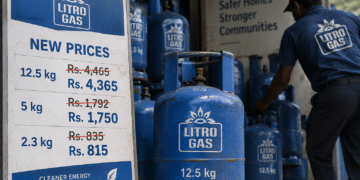
The first thing people notice is usually the price at the filling station.
But that is actually only the beginning.
A more expensive barrel affects the cost of moving almost everything. Buses and trucks use fuel. Fishing boats use fuel. Construction machinery uses fuel. Farmers need fuel for machinery and transport. Businesses that move goods around the country pay for diesel.
Even products that have nothing to do with petroleum can become more expensive because somebody has to transport them.
There is also the foreign-exchange problem.
Sri Lanka has to pay for imported petroleum in foreign currency. If the international price goes up, the country needs more dollars to buy roughly the same amount of fuel.
The Central Bank has already noted the pressure from the Middle East conflict. By the end of July, the rupee had depreciated 7.8% against the US dollar on a year-to-date basis.
That does not mean an oil price increase automatically produces an equivalent increase in local fuel prices. Sri Lanka’s domestic prices also depend on refined fuel prices, freight, taxes, exchange rates and the pricing mechanism used by the authorities.
But the pressure is fairly straightforward.
What an oil shock can look like in Sri Lanka
At the pump: higher international fuel costs can eventually put upward pressure on petrol and diesel prices.
On the road: transport operators face higher running costs.
In shops: transporting food and other goods becomes more expensive.
For businesses: logistics and energy costs squeeze margins.
For the country: a larger petroleum bill means more foreign currency is required for imports.
This does not mean Sri Lanka is heading back to 2022
There is a temptation to make that comparison whenever oil prices start climbing.
It would be premature here.
Sri Lanka is not currently facing the physical fuel shortages that defined the worst months of the 2022 crisis. The country’s external position is also much stronger than it was then.
The more immediate risk is financial.
Sri Lanka can continue getting fuel. The question is how much it will have to pay for it.
That distinction matters.
Diesel may tell us more than petrol
There is a tendency to watch petrol prices because that is what most motorists see.
Economically, diesel may be the more important warning sign.
Trucks, buses, agriculture, construction and a large part of the country’s commercial transport system depend on it. If diesel becomes substantially more expensive, the effect is spread across the economy rather than concentrated among private vehicle owners.
The IEA has already warned that refined products are under pressure, with diesel and other middle distillates particularly tight.
So even if crude prices eventually settle, Sri Lanka will still have to watch what happens to the price of the refined products it actually imports.
The real question is not whether oil will rise
It already has.
The question is how long the disruption lasts — and how many routes are affected before the market gets some breathing room.
If the Saudi pipeline is repaired quickly and shipping through the region begins to recover, the impact on Sri Lanka could remain manageable.
The dangerous scenario is a prolonged squeeze
One pipeline being shut for a few days is a problem.
Several major oil routes being unreliable for weeks is something else entirely.
That is why the developments around Hormuz, the Saudi pipeline and Bab el-Mandeb need to be watched together rather than as separate Middle East stories.
Hormuz is the major eastern exit from the Gulf. The Saudi pipeline was one of the ways around it. Bab el-Mandeb controls the southern entrance to the Red Sea.
If all three remain under serious pressure, the market loses flexibility.
And oil markets do not need the entire supply to disappear before prices react. They react when traders begin to believe that replacing a missing barrel will be difficult.
What Sri Lanka should be watching now
For Colombo, there are a handful of numbers that will tell us whether this is becoming a genuine economic problem.
- Brent crude: Does it remain above $100 or move considerably higher?
- Saudi pipeline: How quickly does the East-West line return to service?
- Hormuz: Do tanker movements begin to recover?
- Bab el-Mandeb: Does the Houthi advance lead to further disruption of Red Sea shipping?
- Diesel: Are refined-product prices rising faster than crude?
- Sri Lanka’s monthly fuel bill: Does the import cost continue accelerating?
- The rupee: Does the higher dollar demand from imports add fresh pressure?
For Sri Lanka, the danger is what comes after the headline
The drone attack on Saudi Arabia’s East-West pipeline may seem distant from Colombo.
It isn’t.
Sri Lanka was already spending billions of dollars a year on fuel. The first half of 2026 alone cost the country about US$3.17 billion, nearly 59% more than the same period last year.
At the same time, the global oil market is losing supply, inventories are being drawn down and the routes that normally give producers some flexibility are becoming harder to rely on.
None of that guarantees another Sri Lankan fuel crisis.
But it does mean that every additional week of disruption matters.
The Saudi pipeline was supposed to be one of the world’s escape routes when Hormuz became dangerous.
Now that escape route has become part of the problem.