












Sri Lanka earned about US$1.5 billion from tea exports in 2025. Behind that export figure, however, the estates producing one of the country’s best-known commodities are operating with a workforce that has been shrinking for more than a decade.
Central Bank plantation statistics show labour grades at regional plantation companies falling from 171,510 in 2014 to 93,207 in 2024.
That is a reduction of almost 46% in ten years.
If the estates had compensated for fewer workers by producing considerably more from each hectare, the demographic change might have represented a difficult transition towards a more productive plantation model.
The yield figures tell a less comfortable story.
A workforce that keeps getting smaller
Plantation companies have spoken about labour shortages for years. The long-term numbers make it difficult to treat the problem as a temporary recruitment cycle.
RPC labour grades stood at 171,510 in 2014. They fell to 163,777 the following year, then 153,152 in 2016. By 2018 the number was below 130,000. It reached 116,212 in 2021 and 93,207 in 2024.
The decline is connected to a change taking place inside estate communities themselves.
Plantation employment once depended heavily on a resident workforce whose families often remained connected to the estates across generations. That labour supply can no longer be assumed.
Younger people have more routes out. Tourism, retail, construction, transport, factories, overseas employment and urban service jobs compete for the same workers. Education has expanded those choices further.
Tea plucking and rubber tapping are also physically demanding occupations. Much of the work takes place outdoors, on slopes and in changing weather. The attraction of another occupation does not have to be particularly high if the alternative offers more predictable hours, a different social status or a clearer route to higher earnings.
The International Labour Organization has previously identified outmigration, ageing workers, working conditions and difficulties attracting younger people among the pressures affecting Sri Lanka’s plantation sector.
The yield figures did not rise as workers disappeared
A falling agricultural workforce does not necessarily cause a production crisis.
Farm economies around the world have reduced labour requirements through machinery, better planting material, irrigation, improved field layouts, data-led management and higher output from each worker.
That transition becomes harder to see in Sri Lanka’s RPC numbers.
Plantation-company tea yield stood at 1,248 kilograms per hectare in 2014. By 2024 it was 1,003 kilograms.
Rubber moved from 831 kilograms per hectare to 636 kilograms over the same period.
| RPC indicator | 2014 | 2024 | Change |
|---|---|---|---|
| Labour grades | 171,510 | 93,207 | -45.7% |
| Tea yield | 1,248 kg/ha | 1,003 kg/ha | -19.6% |
| Rubber yield | 831 kg/ha | 636 kg/ha | -23.5% |
Those movements matter because fewer workers and lower yield can become mutually reinforcing.
A shortage of labour does not affect only the day when tea has to be plucked. Estates need people for pruning, fertiliser application, drainage, weed management, replanting, shade management, road maintenance and other field work.
Delays accumulate.
A field that receives less maintenance can later produce less leaf. Lower production then places more cost on every kilogram harvested. That leaves less room for wages and reinvestment, making the estate less attractive to workers and delaying another round of field improvement.
The cycle can run for years before its full effect becomes obvious in national export statistics.
Kenya exposes the size of the tea productivity difference
The comparison with Kenya requires some care, but it is difficult to dismiss.
Kenya’s official Economic Survey recorded an average 2024 made-tea yield of 2,603.5 kilograms per hectare for estates. Sri Lankan plantation companies recorded 1,003 kilograms per hectare.
Kenya produced 598.5 million kilograms of made tea during 2024. Sri Lanka produced considerably less, although the two industries do not compete on volume alone.
Sri Lanka’s orthodox teas occupy different market positions and Ceylon Tea can earn a substantial price premium. The Export Development Board puts tea export revenue at about US$1.50 billion in 2025.
Price therefore gives Sri Lanka some protection from lower physical productivity.
It does not erase the production cost attached to every kilogram.
Premium tea can carry lower yields only so far
A higher export price allows Sri Lanka to earn more from a smaller crop. Estate economics still depend on the cost of producing that crop. When labour, inputs and field maintenance become expensive while hectare yield remains low, the premium has to absorb an increasing amount of inefficiency before it becomes profit.
Rubber reveals an unusual problem inside Sri Lanka itself
The rubber numbers produce an even more interesting comparison.
Sri Lanka’s Rubber Research Institute reports a national average rubber yield of 1,214 kilograms per hectare for 2024.
The Central Bank series places plantation-company rubber yield at only 636 kilograms per hectare.
The RPC figure was therefore only about 52% of the national average.
This comparison matters because it removes some of the usual problems associated with comparing Sri Lanka against another country. Both figures sit inside the same national rubber economy.
Vietnam still provides useful international context. Its national statistics recorded about 1.30 million tonnes of rubber production in 2024 from a rubber-growing area of about 908,900 hectares. Individual Vietnamese plantation companies have also reported yields around or above 1.9 tonnes per hectare.
The figures are not directly interchangeable with Sri Lanka’s RPC measure because mature area, tapping area and company structures differ. They do show the production scale and field efficiency with which Sri Lankan rubber has to compete internationally.
Ageing fields cannot be repaired with recruitment drives
The labour shortage receives attention because people are visible.
The age of a tea bush is not.
Replanting requires an estate to remove an existing productive field, prepare the land and wait while new tea develops. Revenue is lost before the replacement field begins producing commercially.
That creates a temptation to postpone the work.
One delayed field does little damage to an entire company. Repeating the decision year after year changes the age structure of the estate.
Older tea may remain productive, but declining bushes, gaps, disease, soil conditions and outdated planting layouts can pull hectare yield downward. New machinery is also harder to introduce when rows were planted for an entirely different production system.
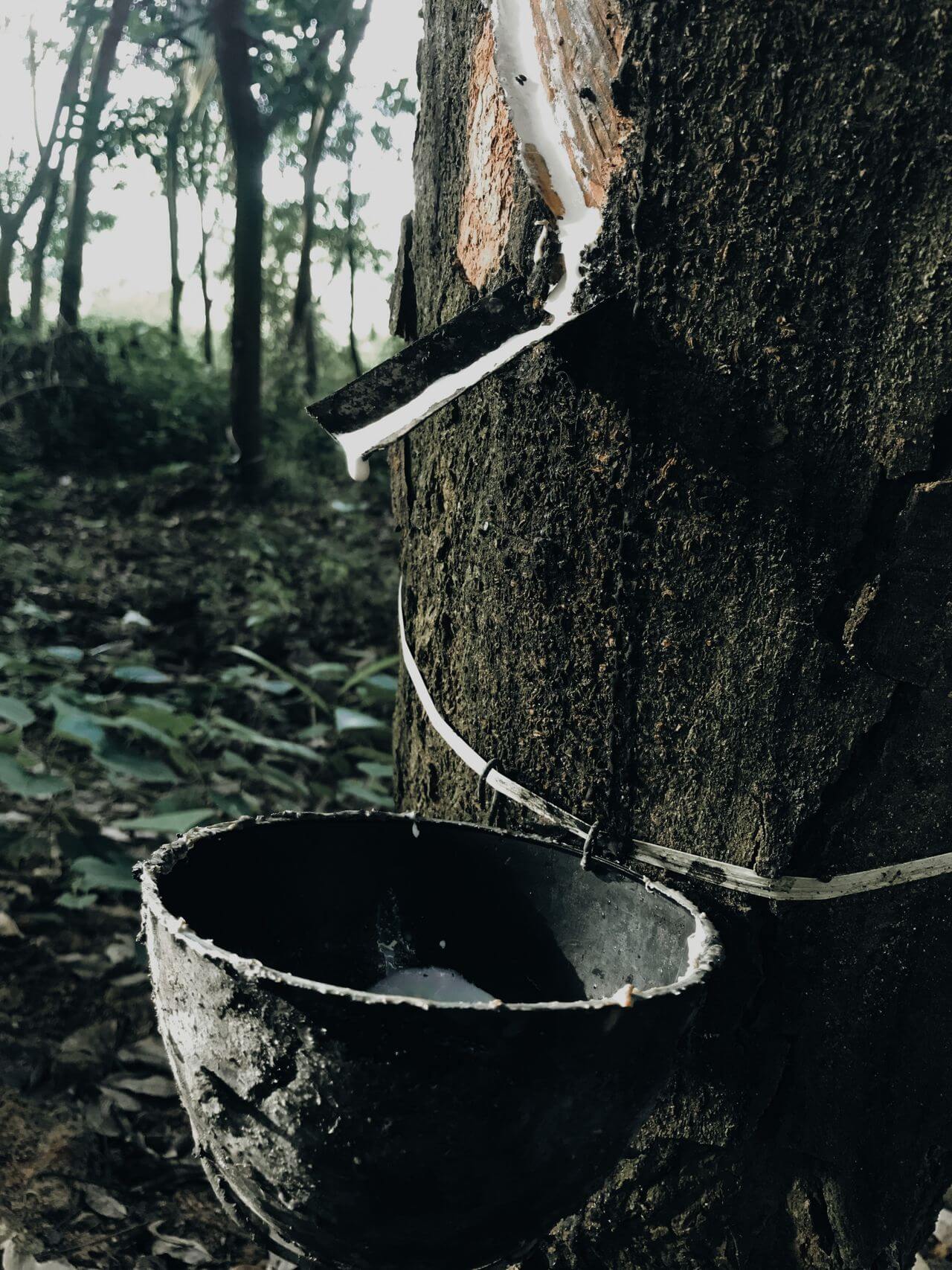
Rubber faces a comparable biological constraint. Trees have productive tapping lives. Replanting cannot be postponed indefinitely without changing future output.
Sri Lanka’s national rubber data recorded only 843 hectares of replanting in 2024, compared with 3,243 hectares in 2012.
That does not prove that every low-yielding plantation has failed to replant. It does show how much less renewal is taking place across the sector than a decade earlier.
The Tea Board is already preparing fields for machines
One of the clearest signs of where the industry is heading appears in the Sri Lanka Tea Board’s own assistance programme.
Its 2026 scheme for high-density planting supports field designs intended for mechanised harvesting. The requirements include double-hedge planting, suitable irrigation and layouts capable of accommodating motorised, electric or battery-operated harvesters.
The design matters as much as the machine.
A harvester cannot operate efficiently everywhere. Steep terrain, irregular rows, old planting patterns and difficult access can restrict its usefulness. Mechanical harvesting also raises questions about leaf selection and quality, particularly in an industry whose international reputation has been built partly around carefully harvested orthodox tea.
For suitable fields, however, the economics are becoming difficult to ignore.
If an estate expects the available workforce to keep declining, every worker remaining in the system has to manage more productive output.
The plantation job may have to change with the field
For decades, the estate model assumed access to a large resident workforce.
That assumption is weakening.
Plantations now compete for workers with businesses that were not serious alternatives for many estate families a generation ago.
Wages remain part of that competition, but the arithmetic does not stop there.
If a low-yielding hectare requires high labour input, every wage increase places additional pressure on the cost of production. If a worker using better equipment can cover more land and work in a higher-yielding field, the estate has more room to raise earnings without transferring the entire cost into each kilogram of tea or rubber.
This is why the wage debate and productivity debate cannot remain separate.
Different companies have experimented with task-based systems, mechanised harvesting, productivity incentives and forms of revenue sharing. Each approach creates its own labour and management questions.
The basic calculation remains the same: how much economic value can one hectare produce, how many worker-days are required to produce it, and how much of that value reaches the worker?
The export numbers can hide the weakness for years
Sri Lanka’s tea exports provide a useful example.
The country earned about US$1.5 billion from tea in 2025. That makes tea one of Sri Lanka’s major merchandise export industries and explains why field productivity is not merely an estate-company issue.
Lakbima News previously used the same scale of tea earnings while examining the size of alleged illicit foreign-currency outflows in The US$1 Billion Question.
Strong export prices can support national earnings even when conditions inside the production system are less healthy.
The same problem appears elsewhere in agriculture. Farmers can face weak returns or production constraints even while the final product carries significant value further along the chain. Our recent reporting on Sri Lanka’s Maha season and food-security pressure looked at another part of that production problem.
For plantations, a sustained premium price can delay the moment at which low field productivity becomes financially intolerable.
It cannot eliminate that moment.
The productivity figures worth publishing every year
Tea prices and daily wages dominate plantation reporting because both are easy to understand.
They tell only part of the story.
A better plantation scorecard would track:
Sri Lanka cannot build its plantation strategy around persuading every young person born on an estate to remain there.
Leaving plantation employment for another occupation is a normal part of economic mobility.
The industry therefore has to answer a harder production question.
Can substantially fewer workers maintain the tea and rubber output needed from the land?
The numbers available today show that the transition has not yet happened. RPC labour grades have fallen by almost half since 2014. Tea yield per hectare is lower than it was ten years ago. Rubber yield at plantation companies is well below the national average.
Meanwhile, competing producers are continuing to operate at much higher physical output in parts of their industries.
Sri Lanka still has something those yield tables cannot measure: Ceylon Tea commands international recognition and can sell at prices that pure volume producers cannot always match.
Keeping that advantage becomes more expensive when too much labour, land and capital are required to produce every kilogram behind the label.