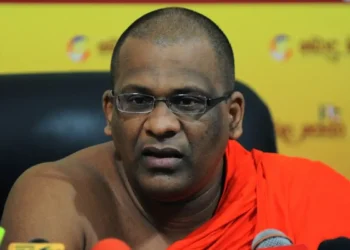











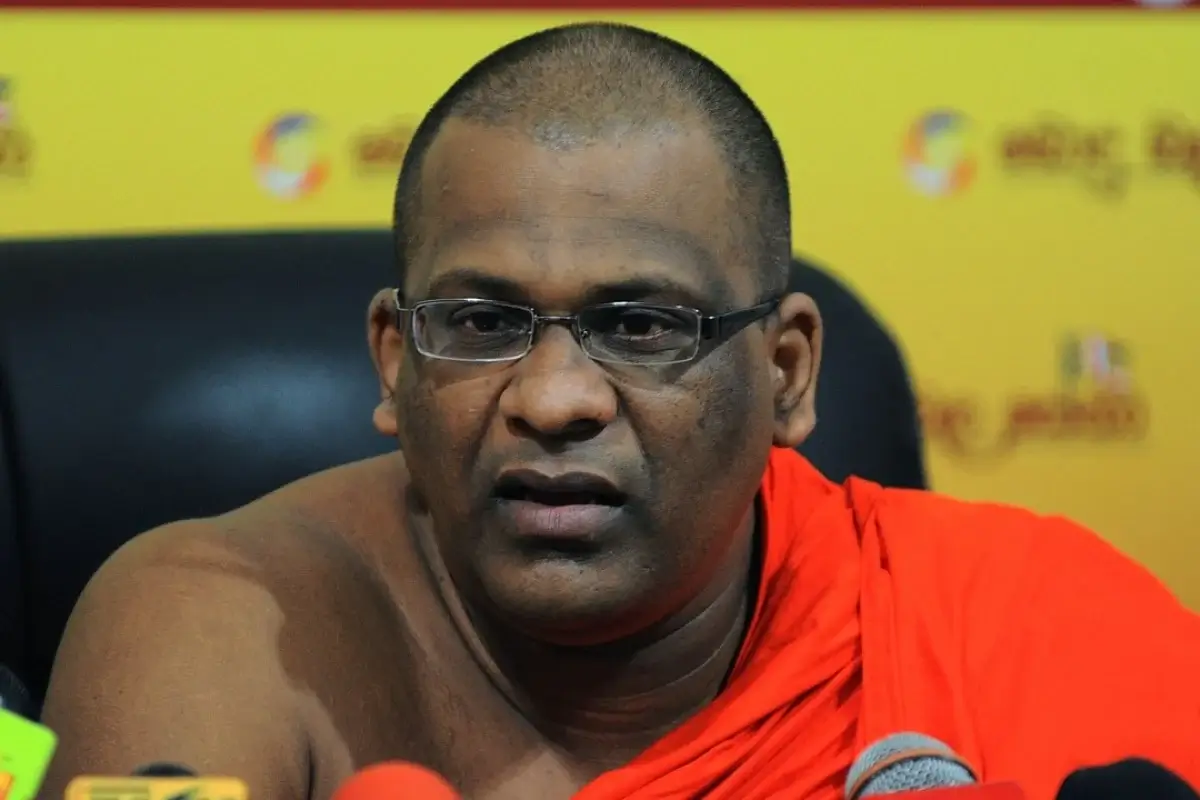
Ven. Galagoda Aththe Gnanasara Thera spent Saturday night in Police custody after officers from the Colombo Crimes Division arrested him at a monastery in the Kalutara area.
He is expected to be produced before court today.
That is the immediate news.
The legal story behind the arrest stretches back more than ten years.
To understand why he was taken into custody now, four dates matter.
It Began in a Courtroom in Homagama
The case at the centre of the latest developments did not begin with a recent speech or political dispute.
It began inside the Homagama Magistrate’s Court.
On 25 January 2016, proceedings were taking place in connection with the disappearance of journalist Prageeth Eknaligoda.
Events involving Gnanasara Thera inside the courtroom later became the basis of contempt proceedings against him.
The case eventually reached the Court of Appeal.
On 8 August 2018, he was convicted on four counts of contempt.
The sentences imposed were four years, four years, six years and five years.
Added together, those terms amount to 19 years.
But they were ordered to operate concurrently.
The effective sentence was therefore six years.
Then Came the Presidential Pardon
On 23 May 2019, then President Maithripala Sirisena granted Gnanasara Thera a presidential pardon.
Only 288 days had passed since the Court of Appeal imposed the sentence.
The Constitution gives the President a substantial clemency power.
Article 34 allows the President to pardon an offender convicted by a Sri Lankan court, suspend the execution of a sentence, substitute a less severe punishment or remit all or part of a punishment.
That power does not make the President another appeal court.
Sri Lanka’s Supreme Court has previously examined the distinction between a judicial conviction and an executive pardon.
A pardon operates on the punishment. It does not amount to another court setting aside the original judgment simply because the executive disagrees with it.
The Pardon Stood for 2,667 Days
From 23 May 2019 until 10 September 2026, 2,667 days passed.
During that period Gnanasara Thera had the benefit of the presidential pardon.
Then the Supreme Court ruled on the challenge to the decision.
The Court held that the pardon granted by former President Sirisena was invalid.
Lakbima News examined the constitutional implications of that ruling shortly after judgment was delivered.
The point that matters now is that invalidating the pardon did not create a new contempt conviction.
The 2018 conviction already existed.
The question became how the sentence attached to that conviction would now be enforced.
Why the Arrest Did Not Happen on September 10
The Supreme Court judgment and the practical enforcement of the old sentence are connected, but they are not the same procedural act.
The Supreme Court dealt with the legality of the presidential pardon.
The question of implementing the existing Court of Appeal sentence subsequently returned to the judicial process.
A motion was taken up before the Court of Appeal.
Gnanasara Thera was required to appear.
He did not appear.
On September 29, the Court of Appeal issued a warrant directing that he be arrested and produced before court.
Twenty three days separated the Supreme Court ruling and the October 3 arrest.
Four days separated the September 29 warrant and the arrest.
There Was Another Warrant
The contempt proceedings were not the only court matter facing Gnanasara Thera by the time of his arrest.
On September 30, the Colombo High Court issued another warrant after he failed to appear in a separate case.
That proceeding concerns allegations relating to statements about Islam and the Quran.
It is not the 2018 contempt case.
| Proceeding | What it concerns | Why the distinction matters |
|---|---|---|
| Court of Appeal contempt matter | The 2018 conviction and the consequences of the 2019 presidential pardon being invalidated | This involves an existing conviction and sentence |
| Colombo High Court proceeding | Separate allegations concerning statements about Islam and the Quran | This is a different case and should not be treated as the contempt conviction |
One person can be subject to court orders from more than one proceeding.
That does not turn those proceedings into one case.
Other Cases Should Not Be Mixed Into This Arrest Either
Gnanasara Thera has faced other proceedings relating to statements concerning Islam and religious harmony.
Some have produced convictions.
Some have involved appeals.
Other proceedings have continued separately.
They may appear similar in a short news report because they involve the same individual and similar subject matter.
Legally they are different matters.
The dates differ.
The alleged statements differ.
The charges differ.
The courts involved can differ.
The stage reached by each proceeding can also differ.
How Much of the Six Year Sentence Remains?
This is another question that should not be answered with simple newsroom arithmetic.
One could count the period between the 2018 sentence and the 2019 pardon and subtract it from six years.
That would not necessarily produce the official period still to be served.
The legal treatment of time already spent in custody, applicable prison rules, remission and later judicial directions can affect the actual calculation.
The competent court and prison authorities should establish that figure.
Until they do, it is safer to say that the original six year concurrent sentence remains relevant following the invalidation of the pardon.
The Arrest Also Raises a Constitutional Question
Presidential pardons are unusual because they allow the executive to affect punishment after a court has convicted a person.
There are legitimate reasons for that power.
Mercy has a place in a justice system.
But the recent litigation surrounding presidential pardons has also made clear that the existence of the power does not necessarily place every use of it beyond judicial examination.
The Constitution gives the President the clemency power.
The courts retain their role in deciding whether constitutional power has been exercised lawfully.
Gnanasara Thera’s arrest is the practical end of that constitutional argument for now.
A sentence imposed by a court was interrupted by a presidential act.
The presidential act was later found invalid.
The courts then returned to the question of enforcing the sentence.
What Happens Today Matters
Gnanasara Thera is due to be produced before court following his arrest by the Colombo Crimes Division.
At the time of publication, Lakbima News had not located a published court order setting out the result of today’s production.
Several questions therefore remain open.
How will the 2018 sentence now be implemented?
What period of that sentence will the relevant authorities treat as remaining?
How will the separate High Court warrant be dealt with?
What directions will be issued regarding the other proceedings already before the courts?
Those answers should come from the court record.