








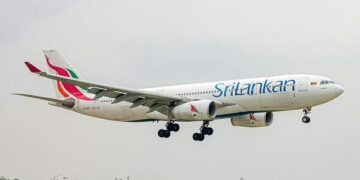


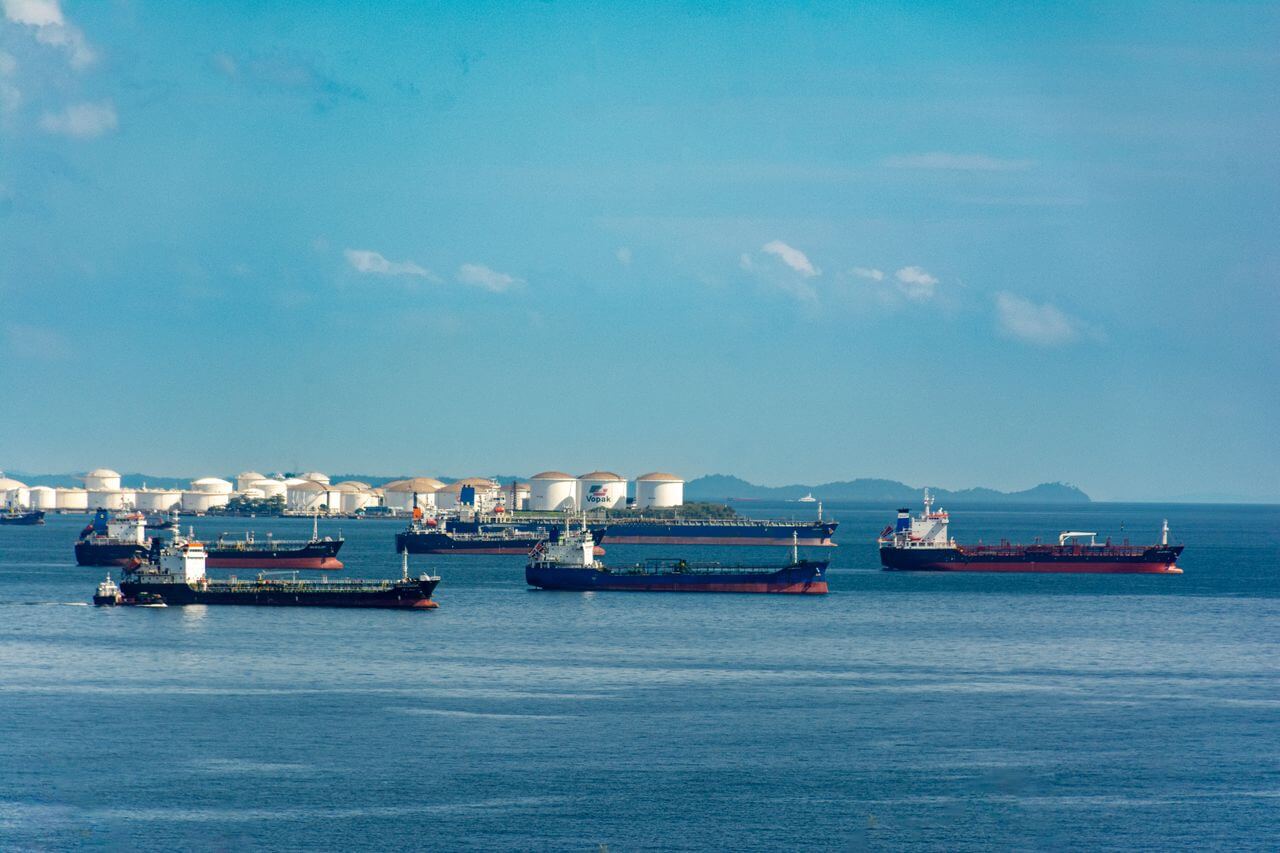
Twenty empty Iran-flagged tankers are waiting off Sri Lanka. They are not carrying fuel for the island. The more important story is what the broken oil route behind them is already costing Sri Lanka.
At first glance, the number is alarming.
Twenty Iranian-flagged oil tankers are sitting off Sri Lanka.
But there is a detail that changes the story almost completely.
They are empty.
They are not a new shipment of Iranian oil waiting to enter Colombo. They are not carrying twenty cargoes that Sri Lanka is somehow being denied. Vessel-monitoring data published on October 1 identifies them as tankers that had already completed ship-to-ship transfers and were left facing a different problem: getting back to Iran.
So Lakbima News followed a different number.
Not 20 ships.
US$4 billion.
That is approximately what Sri Lanka spent importing fuel during the first eight months of 2026.
And that number tells us considerably more about the country’s exposure to the present oil shock than the silhouettes of tankers sitting offshore.
Twenty ships, and a trading cycle that stopped halfway
The latest vessel-monitoring data identifies 20 empty Iran-flagged tankers loitering off Sri Lanka after conducting ship-to-ship transfers.
The list includes DREAM II, STREAM, HALTI, SEA CLIFF, HERO II, SILVIA I, SNOW, HELM, DUNE, DEEP SEA, DIAMOND II, DINO 1, SONIA I, DORE, HERBY, SEVIN, FELICITY, HENNA, AMBER and HUGE.
What happened to them is easier to understand when the oil is separated from the ship carrying it.
This graphic describes the broad movement identified in vessel-monitoring data. Individual vessels may have followed different routes.
The ships have therefore completed one part of their commercial journey but cannot easily begin the next.
From August 23, monitoring data shows that most of the tankers left the Galle anchorage and began moving around the vicinity of Sri Lanka. By September 29, many had relocated to another anchorage further north.
Satellite imagery cited by the monitoring organisation confirmed most of their locations on October 1.
They are not simply twenty ships waiting to unload.
They are twenty ships waiting for somewhere to go.
Why 20 and 47 are not the same number
Anyone following the story over the past several weeks may have noticed another figure: 47 vessels.
Sri Lankan authorities previously referred to a wider group of vessels operating in international waters more than 24 nautical miles from the country.
The latest figure of 20 is narrower. It refers specifically to the empty Iran-flagged tankers identified in the October 1 monitoring data.
The two figures should not be presented as though one replaced the other.
They measure different groups.
Lakbima News previously examined the legal and maritime questions surrounding the vessels in Iranian Ships Off Sri Lanka: Why Are They There, and Should Colombo Be Worried?
What has changed since then is the economic picture.
The number that matters more than 20
While attention has been fixed offshore, Sri Lanka’s fuel-import bill has been moving in the opposite direction.
Central Bank data published on September 30 puts cumulative fuel-import expenditure for January to August 2026 at approximately US$4.0 billion.
That was 61.6 percent higher than during the corresponding eight months of 2025.
Working backwards from the Central Bank’s percentage increase puts the comparable 2025 figure at roughly US$2.48 billion.
The difference is about US$1.52 billion.
Source: Central Bank of Sri Lanka. 2026 figure and percentage change are official CBSL figures. The 2025 amount is a Lakbima News calculation based on the reported percentage change.
That means Sri Lanka found roughly US$1.5 billion more for fuel imports in eight months than it did over the comparable period a year earlier.
That is the economic connection between the crisis at sea and the Sri Lankan consumer.
It is not that these particular tankers contain fuel that belongs to Sri Lanka.
It is that the same geopolitical disruption visible aboard those ships is moving through freight costs, crude markets, foreign exchange and the price Sri Lanka pays to keep fuel entering the country.
The extra fuel bill is large enough to show up in the country’s external accounts
The Central Bank’s August figures show that Sri Lanka’s merchandise trade deficit reached US$7.2 billion during January–August 2026.
During the same period of 2025 it had been US$4.3 billion.
The deterioration was therefore approximately US$2.9 billion.
Fuel cannot be treated as the sole cause of that increase. Imports and exports across the economy determine the trade balance.
But the additional fuel expenditure of roughly US$1.52 billion is large enough to understand the scale of the pressure.
There is another warning in the same Central Bank release.
Sri Lanka’s terms of trade deteriorated during January–August because import prices increased faster than export prices.
By the end of September, the rupee had depreciated 6.3 percent against the US dollar since the beginning of the year.
For an economy buying fuel internationally in foreign currency, those numbers matter.
July shows how quickly the bill can move
The monthly data gives an even clearer view.
Sri Lanka spent approximately US$453 million on fuel imports in July alone.
That was 68 percent higher than July 2025, with the Central Bank attributing the increase mainly to higher expenditure on crude-oil imports.
By the end of July, cumulative fuel imports had already reached approximately US$3.622 billion.
One month later, the eight-month total was approximately US$4 billion.
The important distinction
The tanker count measures ships.
The Central Bank data measures what Sri Lanka is actually paying.
Conflating the two would create a dramatic headline. Separating them reveals the more important economic story.
What an empty tanker still needs
An empty oil tanker is not an inactive object.
It still has a crew. Engines have to operate. Systems need power. Food and drinking water have to reach the people on board. Maintenance continues. Insurance, wages and compliance costs do not disappear simply because the cargo tanks are empty.
That means a vessel prevented from returning to its normal loading cycle becomes increasingly expensive the longer it waits.
The sanctions issue adds another layer.
A company considering whether to provide supplies or services to a vessel connected to sanctioned petroleum activity has to consider not only maritime law, but also its own exposure to sanctions and international financial restrictions.
For Sri Lanka, this creates an unusual situation.
The vessels are close enough to attract national attention.
But their proximity does not automatically make their cargo, commercial problems or operating costs Sri Lanka’s responsibility.
Sri Lanka’s vulnerability begins before a petrol station runs dry
The most dangerous way to measure an oil shock is to wait for a queue at a filling station.
By then, much of the economic damage has already travelled through the system.
This is an analytical transmission path, not a claim that every stage must occur or that the 20 vessels themselves cause these effects.
This is why the tankers matter even though they are empty.
They are a visible symptom of a shipping system under strain.
Sri Lanka is exposed to that system because the country must continue importing petroleum regardless of whether the international market is calm or disrupted.
A useful calculation — with an important warning
If the January–August fuel-import expenditure of approximately US$4 billion were simply extended at the same average monthly pace for twelve months, the arithmetic produces approximately US$6 billion.
There is good reason not to call it a forecast.
Monthly fuel expenditure has already been declining from its earlier peaks. Oil prices can move rapidly. Cargo timing changes monthly import figures. Exchange rates move. Demand changes.
But the calculation is useful for one reason.
It shows the scale of the system Sri Lanka is trying to finance.
Even a relatively small percentage change in the cost of that system can translate into hundreds of millions of dollars.
Twenty tankers are not twenty missing shipments
This is the point that should not disappear beneath the headline.
There is currently no evidence in the material examined by Lakbima News that the 20 empty Iranian tankers represent fuel purchased by Sri Lanka and prevented from reaching the country.
There is also no basis for simply multiplying 20 tankers by an assumed cargo capacity and presenting that number as “oil stranded off Sri Lanka”.
The vessels are reported empty.
Doing that calculation would create a large number, but it would describe oil that is not actually aboard the ships.
The real numbers are less spectacular and more consequential.
US$4 billion spent on fuel in eight months.
A 61.6 percent increase from a year earlier.
A US$7.2 billion trade deficit.
A rupee 6.3 percent weaker against the dollar by the end of September.
Those figures are not floating offshore.
They are already inside Sri Lanka’s economy.
What should Colombo be watching now?
The number of tankers matters, but not in isolation.
If vessels begin leaving the area, that may indicate that part of the shipping cycle is reopening or that operators have found alternative destinations.
If more empty tankers arrive, the opposite question emerges.
But for Sri Lanka, there are more immediate numbers worth following: monthly fuel-import expenditure, international petroleum prices, the exchange rate, the cost of freight and insurance, and the country’s available foreign-exchange reserves.
At the end of August, Sri Lanka’s gross official reserves — including the swap facility with the People’s Bank of China — stood at approximately US$6.9 billion.
Put beside an eight-month fuel-import bill of about US$4 billion, the figures illustrate why petroleum prices cannot be treated as a distant geopolitical story.
That comparison should not be read as saying that reserves are earmarked solely for fuel, or that US$4 billion should simply be subtracted from US$6.9 billion. They measure different things.
What the comparison shows is scale.
Fuel is one of the large foreign-currency demands Sri Lanka has to manage.
The numbers behind the tanker story
Official figures and Lakbima calculations used in this investigation.
| Indicator | Figure | What it means |
|---|---|---|
| Empty Iran-flagged tankers identified off Sri Lanka | 20 | October 1 vessel-monitoring count |
| Fuel imports, Jan–Aug 2026 | ≈ US$4.0bn | Official CBSL cumulative expenditure |
| Fuel-import increase | +61.6% | Compared with Jan–Aug 2025 |
| Derived Jan–Aug 2025 fuel bill | ≈ US$2.48bn | Lakbima calculation from CBSL’s percentage change |
| Approximate additional fuel expenditure | ≈ US$1.52bn | Lakbima calculation |
| July 2026 fuel imports | US$453m | 68% higher year-on-year |
| Trade deficit, Jan–Aug 2026 | US$7.2bn | Compared with US$4.3bn a year earlier |
| Gross official reserves, end-August | US$6.9bn | Includes PBOC swap facility |
| Rupee depreciation, end-September YTD | 6.3% | Against the US dollar |
| Illustrative annualised fuel-import run rate | ≈ US$6.0bn | Lakbima calculation; not a forecast |
The ships are the photograph. The fuel bill is the story.
Twenty Iranian tankers sitting off Sri Lanka make an extraordinary image.
They invite obvious questions about sanctions, sovereignty, Iran and what is happening beyond the horizon.
But the ships themselves can distract from what the numbers are saying on land.
Sri Lanka spent approximately US$4 billion importing fuel in eight months.
That bill was 61.6 percent higher than a year earlier.
The country’s trade deficit widened sharply over the same period.
And the Central Bank itself says pressures on the external sector have been linked to the escalation of the Middle East conflict.
That is why an empty tanker can still matter.
Not because the oil inside it is destined for Sri Lanka.
There is no oil inside it.
It matters because the reason that ship cannot complete its normal journey is part of the same disruption Sri Lanka is paying for every time it purchases another cargo of fuel.
The tankers are waiting.
Sri Lanka cannot.
How Lakbima News calculated the figures
The Central Bank reported approximately US$4.0 billion in cumulative fuel-import expenditure during January–August 2026, a 61.6% year-on-year increase. Lakbima calculated the approximate comparable 2025 value by dividing US$4.0 billion by 1.616, producing roughly US$2.48 billion. The difference is approximately US$1.52 billion.
The US$6.0 billion figure is obtained by annualising the average January–August 2026 expenditure: US$4.0 billion ÷ 8 × 12. It is included only to illustrate scale and is not presented as a forecast.
Rounded published values mean calculated figures are necessarily approximate.
Editor’s Note
This investigation does not establish that the 20 Iran-flagged tankers are responsible for Sri Lanka’s higher fuel-import expenditure. The vessels are examined as a visible consequence of a wider disruption affecting Iranian petroleum movements and international shipping.
The 20 vessels identified in the October 1 monitoring update are described as empty following ship-to-ship transfers. They should not be presented as 20 Iranian oil cargoes waiting to enter Sri Lanka.
Where Lakbima News has derived a figure from published data rather than quoting it directly, that calculation has been identified in the article.