













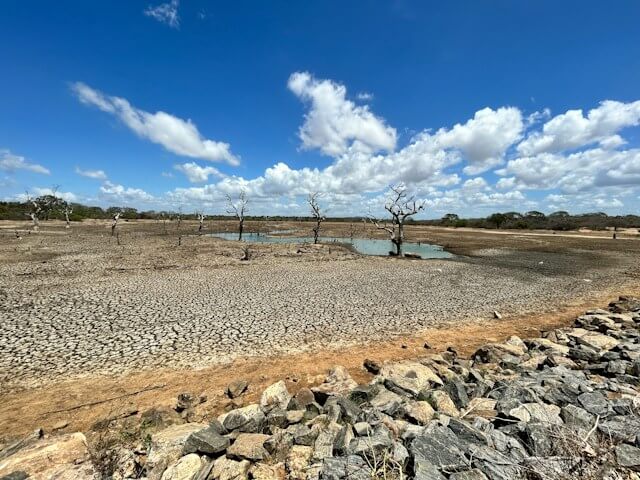
Sri Lanka is heading towards its most important agricultural season with drought conditions already damaging farming communities, El Niño strengthening and the Government preparing to decide how much cultivation the country’s water resources can support. The rice shelves are not empty today. The bigger question is whether they will stay that way if Maha goes badly.
For Sri Lanka, the Maha season is more than another planting cycle. It is one of the foundations of the country’s food supply.
That is why the coming weeks matter.
The Government is preparing to make its final decision on the 2026/27 Maha cultivation programme on September 18, after assessing water availability in reservoirs and consulting farmers, irrigation authorities, Mahaweli officials and other stakeholders. The Department of Meteorology is also being brought into the process because of the developing El Niño conditions.
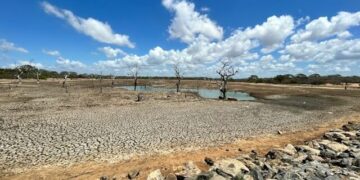
At the same time, Sri Lanka is already experiencing a severe dry spell. Reuters reported rainfall deficits of as much as 85% to 100% below normal in parts of Ampara and Monaragala, while many local tanks were reported to be holding only around 10% of their normal capacity.
This does not mean that Sri Lanka is heading automatically towards a rice crisis. The Government says current rice stocks are adequate and that there are no immediate plans for additional rice imports.
But that is precisely why the Maha season deserves closer attention: today’s rice stocks can provide a buffer, but they cannot replace the next harvest indefinitely.
How much of Maha can Sri Lanka actually afford to plant?
The answer will depend on the amount of water available, the timing of rainfall, reservoir inflows and the crops farmers are permitted to cultivate.
Maha is ultimately a food-supply decision
A smaller cultivated area or lower yields could eventually affect rice availability, farmer incomes and food prices — even if there is no shortage immediately.
The numbers that explain the pressure
The warning is already showing up in food prices
Sri Lanka is not starting this season from a position of falling food prices.
According to the Central Bank of Sri Lanka, food inflation accelerated to 8.5% in August 2026, from 6.3% in July. Headline inflation also increased to 8.0%.
That increase cannot simply be blamed on the drought. Food prices are affected by many factors, including supply conditions, imports, transport, energy and individual commodity prices.
But it means the room for another major agricultural supply shock is smaller than it would be if food inflation were already comfortably low.
For some farming communities, the problem has already arrived
Reuters reported that parts of eastern and southeastern Sri Lanka have experienced exceptionally severe rainfall deficits.
In Ampara and Monaragala, rainfall deficits were reported at 85% to 100% below normal in some areas. Wells, rivers and smaller tanks have dried up, while some communities have had to rely on water deliveries.
The impact is not limited to paddy. Farmers have reported losses in other crops and reductions in household income as agricultural activity becomes increasingly difficult.
This matters because the Maha decision is being made against a drought that is already affecting livelihoods — not against a theoretical climate forecast.
Then there is El Niño
The World Meteorological Organization’s latest assessment is unusually strong.
WMO says El Niño is firmly established and is expected to strengthen further. Its forecasts show a near-100% likelihood that the event will persist through February 2027.
WMO also expects the event to reach very strong intensity before peaking towards the end of 2026.
That does not mean every part of Sri Lanka will automatically receive less rainfall. WMO itself cautions that the strength of an El Niño event does not translate directly into the magnitude of impacts in every region.
The important point for Sri Lanka is that the climate signal is strong enough for authorities to incorporate it into agricultural planning.
How Sri Lanka got here
Sri Lanka recorded around 5.05 million metric tons of paddy production, according to Central Bank data, supported by strong Yala production.
The Maha crop was affected by weather damage including Cyclone Ditwah. The Central Bank’s March 2026 bulletin estimated production at around 2.64 million metric tons.
Irrigation authorities said major reservoirs were holding around 50% of total storage capacity at the time and preparations were being made for the next cultivation cycle.
Severe dry conditions are affecting farming communities while WMO warns that El Niño is strengthening.
The Government is scheduled to make the final decision on Maha cultivation, including the start of cultivation and water allocation.
Sri Lanka is not starting from zero
There is an important reason not to overstate the current risk.
Sri Lanka’s rice position is considerably stronger than it was during the 2022 economic crisis.
Central Bank data show that total paddy production reached approximately 5.05 million metric tons in 2025, up 7.6% from 2024. Yala production was particularly strong at about 2.31 million metric tons.
The Agriculture Ministry also said earlier this year that the country had returned to a position of sufficient rice availability after shortages seen in the latter part of 2024.
That gives the country something extremely valuable during a drought: time.
But time is useful only if policymakers use it to protect the next harvest.
Rice stocks are buying Sri Lanka time
The Government says there is currently no need for additional rice imports because sufficient stocks are available.
In August, Cabinet approved a plan to mill 30,000 metric tons of paddy held by the Paddy Marketing Board and release the resulting rice through state and private distribution channels.
That is an important buffer mechanism. It can increase market supply and help move stored paddy into usable rice stocks.
But stored paddy is finite. If the next major harvest is significantly reduced, the country would eventually have to choose between allowing prices to rise, drawing down reserves further or importing more.
The Government is already changing the playbook
Officials are not simply waiting for the weather.
Shorter-duration rice
The Agriculture Department has recommended greater attention to paddy varieties that can be harvested in roughly two and a half months.
Better water storage
Authorities have stressed the importance of storing available rainwater and maintaining irrigation infrastructure before the expected rains.
Alternative crops
Officials are examining whether crops such as maize could be cultivated in some areas where normal paddy cultivation would put excessive pressure on water resources.
Why minor irrigation matters
The Department of Agrarian Development manages minor irrigation systems covering around 289,000 hectares of paddy land.
These systems therefore represent a significant part of the country’s agricultural water-management equation. Maintaining canals, spillways and other infrastructure before rainfall arrives could determine how effectively whatever rain does come can be captured and used.
The real risk is not simply “no rain”
The more complicated risk is a mismatch between when rain arrives, how much water is stored and what farmers have already planted.
A delayed rainfall pattern can cause problems even if total seasonal rainfall eventually looks less alarming on paper.
Farmers need water at particular stages of crop development. Reservoirs need inflows before irrigation releases can safely be increased. And planting too much land before water availability is known can leave crops competing for insufficient supplies later in the season.
This is why the September 18 decision is important.
The question is not how much land Sri Lanka would like to cultivate. It is how much land Sri Lanka can responsibly promise water to.
Three possible Maha scenarios
Rains recover
Reservoirs receive sufficient inflows and cultivation proceeds broadly as planned. Existing rice stocks provide additional protection.
Risk: manageableMixed rainfall
Some areas receive adequate rainfall while others remain dry. Cultivation may need to be staggered, reduced or shifted towards shorter-duration crops.
Risk: unevenDrought persists
Lower cultivation, reduced yields and weaker farmer incomes could eventually put greater pressure on rice stocks and food prices.
Risk: highWhat we know
- El Niño is firmly established and expected to strengthen.
- WMO puts the likelihood of persistence through February 2027 at nearly 100%.
- Some Sri Lankan farming areas are already experiencing severe drought.
- Food inflation reached 8.5% in August.
- The Government says current rice stocks are adequate.
- The final Maha cultivation decision is scheduled for September 18.
- Authorities are preparing water-management and crop-adjustment measures.
What we do not know yet
- Exactly how much land will ultimately be cultivated during Maha.
- How much rainfall Sri Lanka will receive during the key cultivation period.
- How reservoir storage will change before and during cultivation.
- How large any eventual production loss could be.
- Whether current rice stocks would be sufficient if Maha production falls sharply.
- Whether additional rice imports will eventually become necessary.
One important distinction
It would be wrong to say that Sri Lanka is already facing a nationwide rice shortage because of the drought.
The available evidence does not establish that.
It would also be wrong to assume that adequate rice stocks today guarantee adequate supply next year.
The evidence supports a more measured conclusion: Sri Lanka has a buffer, but the strength of that buffer depends increasingly on what happens to the Maha harvest.
What Lakbima News will be watching
How much land will be approved for cultivation?
How much usable irrigation water is actually available?
Do the expected rains arrive at the right time?
What happens to cultivated extent and yields?
How much buffer remains after market releases?
Does food inflation continue to accelerate?
Sri Lanka does not have a rice crisis yet. But the Maha season could decide whether it gets one.
The country’s current position is stronger than during the 2022 crisis. Paddy production recovered significantly in 2025, government stocks provide a buffer and authorities are actively preparing for the coming season.
But the current drought, strengthening El Niño and rising food inflation mean complacency would be dangerous.
The Government’s most important task is therefore not simply to maximize the amount of land planted. It is to match cultivation with realistic water availability, protect farmers from avoidable losses and preserve enough rice stocks to absorb a poor harvest if the weather turns against the country.
The success of Maha should ultimately be measured not by how much land is announced for cultivation, but by how much food Sri Lanka can safely produce with the water it has.
Sources & further reading
Lakbima News has used official government, meteorological, agricultural and economic sources wherever available. Media reports are used for independently reported developments and on-the-ground information.
Primary / official sources
- World Meteorological Organization – El Niño update, September 2026
- Central Bank of Sri Lanka – August 2026 inflation data
- Department of Census and Statistics – Paddy Statistics
- Irrigation Department – Reservoir Status
- Ministry of Agriculture – Water Management Committee and El Niño preparations
- Department of Agriculture – Drought-tolerant rice varieties
- Cabinet Office – 30,000 MT Paddy Marketing Board stocks to be milled into rice
Independent / media reporting
Editorial note: This article distinguishes between confirmed conditions, government statements, forecasts and potential scenarios. El Niño forecasts describe increased climate risks; they do not by themselves establish the exact rainfall or agricultural outcome for Sri Lanka. The final Maha cultivation decision and subsequent reservoir, rainfall and production data may change the assessment presented here.