















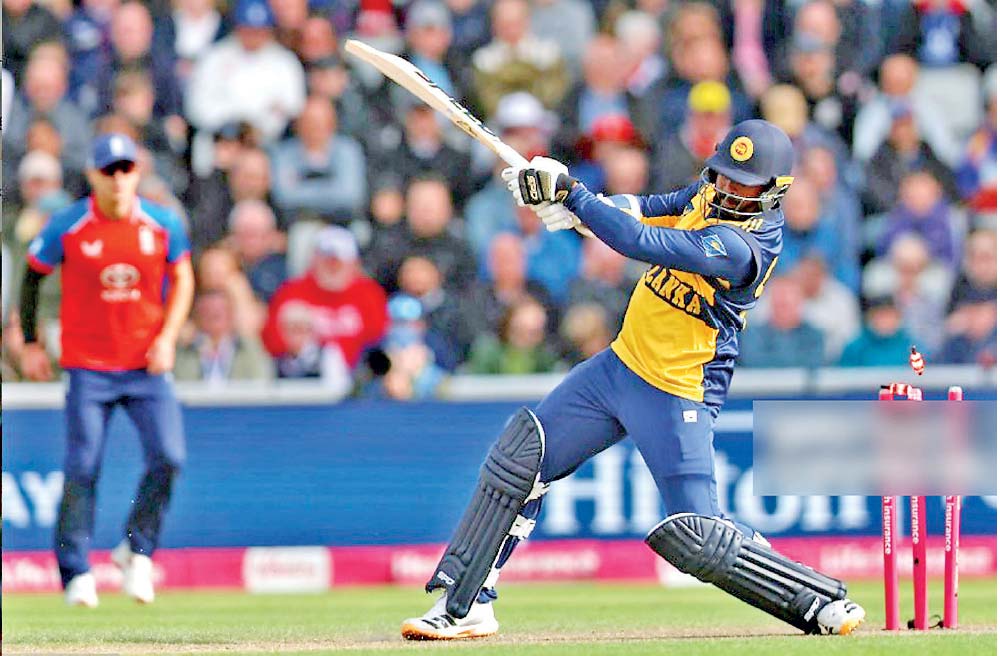
- There has been a gradual decline since 2016
By Sa’adi Thawfeeq
Sri Lanka’s T20I cricket has reached its nadir, and their recent 3-0 drubbing at the hands of high-riding England only goes to show the gulf that exists not only between the two teams but against some of the other cricketing nations as well.
T20 cricket is all about batting, and Sri Lanka are struggling to put totals on the board which their bowlers could exploit.
For a nation that has produced such brilliant white-ball batsmen like Aravinda de Silva, Sanath Jayasuriya, Tillakaratne Dilshan, Mahela Jayawardene, and Kumar Sangakkara, the gradual decline of quality batsmen in the shortest format is quite alarming. The last of this lot quit cricket in 2016, and since then, Sri Lanka have been struggling to find batsmen who could go and win matches for the country consistently.
Actually, no one has taken the trouble to see why such a decline has taken place, but kept on picking players who were not worthy enough to give other nations strong opposition as teams of the past had done.
Selection has to be done on what is available at hand. What is available is not good enough to win matches. A clear example of where Sri Lanka’s batting lies can be gauged by the fact that the Indian Premier League (IPL), which is considered the best of the lot played around the world, hardly picks a Sri Lankan batsman. Those picked by the IPL franchises are mostly bowlers. Therein lies the key to Sri Lanka’s problem.
Sri Lanka lack quality batsmen who can score runs at a fast pace in the powerplay, the middle overs, and at the death. There is a grave shortage of power hitters who can clear the boundary. One doubts whether the Lanka Premier League (LPL), which has been in existence for the past six years, helps produce quality T20 batsmen. Although some of the matches played have been close, the quality of cricket played cannot be compared to that of the IPL.
For Sri Lanka’s T20 cricket to improve, you need the current top players in the world playing in the LPL, not just players who have retired or players just making the leagues for a living. Even the domestic T20 matches hardly produce tall scores. All this boils down to preparing good pitches for batting where the batsmen can develop their skill to score runs and bat freely without fear. The lack of quality pitches could be one of the reasons why Sri Lanka have fallen far behind other nations in the shortest format.
The pitches that England produced for the three T20Is against Sri Lanka were all batting-friendly, but our batsmen failed to take advantage of it and failed miserably, getting totals of 135, 145-9, and 124, which hardly offered any challenge to the England batters or bowlers.
Sri Lanka are also guilty of trying to achieve short-term goals by producing wickets to win matches at home, but get glaringly exposed when they travel abroad, as the current England tour has highlighted.
These are administrative failures that have pushed back the nation’s cricket to what it is today.
For Sri Lanka, who are at the bottom of the ladder, the only way to go is up. For that to happen, certain things have to be put right in the proper perspective.