











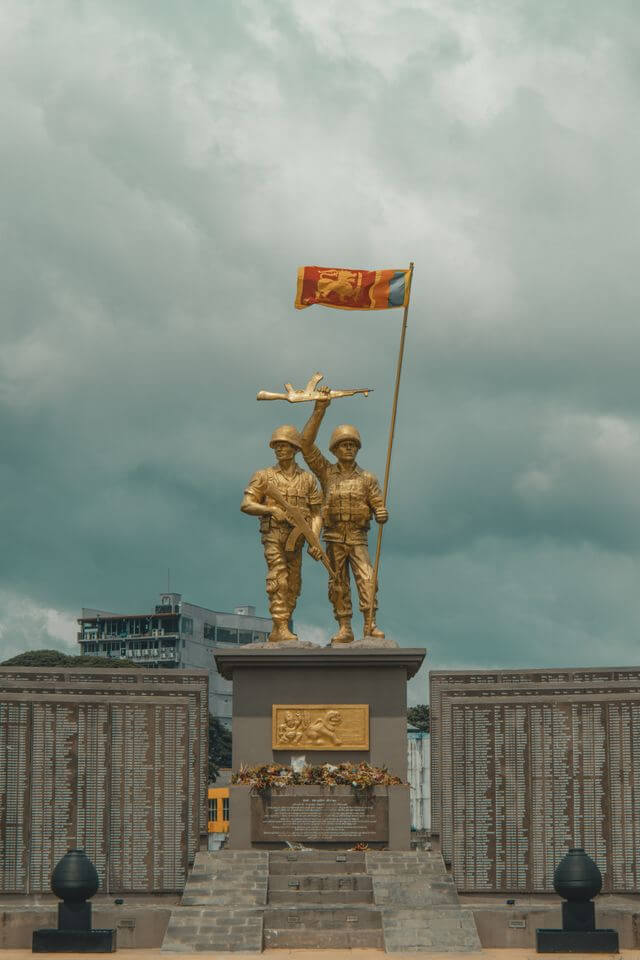
Army’s new civilian role – is this a good signal?
By Ranga Jayasuriya
The government has assigned the army to supervise garbage collection in the city of Colombo. The collection of garbage would continue to be the responsibility of the private companies contracted by the Colombo Municipal Council. Soldiers will however supervise the process; army bikers will travel in the city in the early morning to monitor whether private contractors have done their job. That is part of a wider programme by the Urban Development Authority (UDA), which comes under the purview of the Ministry of Defence, for the beautification of the city of Colombo. Earlier, the UDA instructed the owners of run-down business premises in the city to colour-wash their buildings, install new toilets and not to litter the surroundings. All that is fine, and was in fact long overdue for Sri Lanka’s informal and small scale business ventures, which badly needed to be regulated.
However, the government’s strategy also highlights a disturbing aspect: The spreading tentacles of the military machine into areas which were not traditionally under the purview of the military. In other words, the militarization of civil society. (Sri Lanka, not coup prone Pakistan, is the most militarized country in South Asia in terms of the ratio of military personnel to population.)
Retired/serving service personnel hold senior govt. posts
This government has also employed a disproportionate number of retired and serving military personnel in senior government jobs and diplomatic postings. The latest appointment was of former navy chief vice admiral Thisara Samarasinghe as Sri Lanka’s High Commissioner in Australia. In addition, the Governors of the North and Eastern Provinces — former Security Forces Commander Jaffna, General G A Chandrasiri and Rear Admiral Mohan Wijewickrema, respectively, are former military men.
The government continues to expand the military role in civil affairs, presumably, to induct surplus man-power of the country’s bloated military into development work. The three branches of the Sri Lankan security forces – army, navy and air force – have approximately 300,000 personnel under their rank and file.
Earlier, the navy was assigned to run a canal boat service from Wellawatta to Nawala. Four boats have been deployed in the morning and evening to ferry passengers. In addition, the navy launched a boat service for tourists who visit Sand Banks located between the Indian coastal town of Rameshwaram and Thalaimannar. Whale watching tours, another enterprise by the navy holds a potential for success. Navy passenger vessel A-543 with tourists aboard sails from Galle Port to Mirissa, four times a week for whale watching.
Military run ventures
In addition, the army recently converted the Thalsevana in Kankasanthurai, a former army officers’ mess and a circuit bungalow, into a 22 room luxury holiday resort for the public. Thalsevana is situated near the KKS Cement Factory and inside the High Security Zone, of which original inhabitants continue to languish in displacement.
The army also runs two holiday resorts in Kukuleganga, in the vicinity of the UN Peace Keeping School and in Wadduwa, which is one of the oldest such ventures of the army.
Such military run businesses are not an aberration: The Indian Army runs over 100 golf courses and sports clubs, which have recently been the focus of a corruption probe by the country’s auditor. Pakistani military runs a wide-range of businesses, estimated to be worth around US$ 20 billion, ranging from bakeries to sprawling industrial complexes.
Turkey and the Peoples Republic of China are two other examples where the military owns substantial assets in economic ventures.
Indonesia is an exception in recent times. Its military was ordered to hand over its lucrative business enterprises worth US$ 240 million to the civilian controlled ministry of defence.
Even under the most generous estimate, the penetration of the Sri Lankan military into the local economy is minuscule.
Most disturbing decision
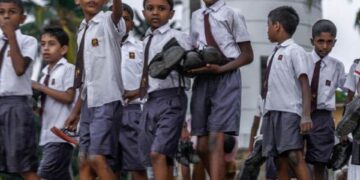
However, perhaps the most disturbing decision which smacks of militarization was announced by the Ministry of Higher Education, which now plans to send new intakes of undergraduates to military installations for a three week leadership training programme. The young university hopefuls will be trained by military officers in leadership skills, English and social etiquette, etc.
Sri Lankan universities have an admission criterion which is heavily weighted on affirmative action, which, rightly so, enables students from least developed parts of the country to enter university with lesser marks than the rest. That however creates a huge disparity, in both intellectual and other normative values, an area exploited by the student activists aligned with the JVP. Therefore, no doubt that leadership training would be useful for young undergraduates and would instill a degree of self confidence in them.
However the million dollar question is, why is the military assigned to train students?
Minister S B Dissanayake says army camps are the only place where students could be accommodated on a large scale.
The choice is, however, fraught with danger of militarizing the seats of higher learning of this country.
Claims preeminence
Militarization of civil society doesn’t happen overnight. It is a gradual process. Soon after the partition, there were three pillars of power in Pakistan: a nascent civilian bureaucracy and a latent political leadership and the military, which was the most organized among the three. As trouble brewed in the form of sectarian clashes and a malfunctioning economy, the military claimed preeminence in state affairs. The country went under a series of military regimes during the next six decades of independence.
In Indonesia, civilian leaderships such as that of independent leader, Sukarno, granted excessive powers to the military to crush a communist insurgency.
These powers were never taken back and a couple of years later, the military ousted Sukarno and General Suharto ruled the archipelago for the next three decades.
Playing with fire
The Rajapaksa Administration relies on military personnel to conduct a wide range of none-military affairs (see main story) because it prefers and trusts the military. (So did Sukarno until his ouster).
It is no surprise that it is the navy that provides catering services at Temple Trees.
Another reason the government relies on the military is that the soldiers are more efficient in providing basic services and supervising these services than some of the crooked private sector contractors.
For instance, why soldiers supervise garbage collection is that private contractors and their sub contractors who were assigned with the task do not do a proper job. They leave heaps of garbage by the roadside and drive open garbage tractors in the rush hour morning traffic. Elected representatives of CMC and other municipalities, who are facing serious corruption charges, turn a blind eye and sometimes profit from racketeers.
It is the failure of the public sector that has propelled the penetration of the military into civilian affairs.
That’s exactly what happened in some of the newly independent former colonies, of which latent civilian bureaucracy was eclipsed by a better organized military which later ousted the civilian political leaderships.
Though Sri Lanka’s situation is not aggravated as in some of her friendly nations such as Pakistan, Bangladesh, etc, this country is playing with fire. Social, political and geographic realities in Sri Lanka are such that, that a military coup is a long shot. But, worse still, spreading tentacles of the military would erode the social fabric. The government should strengthen and regulate the private sector and instill new life into the inept public sector. Civilized countries did not send troops to supervise garbage collection; instead, they regulated the process through private -public sector participation. They empowered civil society and instilled it with a new sense of awareness and responsibility.
After three decades of war, this government should have demilitarized society; instead, it opts to do the exact opposite.